








Russia, to possibly divert global attention from its continuing atrocities and struggling military goals in Ukraine, while seizing a chance to act as a responsible world power, is trying to take a major role influencing how various United Nations bodies react to the current Israeli-Hamas war.
Yet the recent moves by Russia at the UN to act as a credible advocate for protecting civilians in the Mideast war occur as a new report on the latest instances of Russian torture, rape and other abject human rights violations in Ukraine has been released by the UN Independent International Commission of Inquiry. Russia, the commission attests, has been breaching international laws in its full-throttled violence against its neighbor since February 2022.
The extent of Russia’s influence at the UN regarding the Israeli-Hamas war, which erupted on Oct. 7, may be far less important, however, than the actions of the United States right now. A new draft resolution circulated by the US among fellow Security Council members emphasizes Israel’s right to self-defense. It follows two draft resolutions that focused on urgent humanitarian aid for Gaza that failed last week. The US vetoed one submitted by Brazil, and a Russian-led rival draft didn’t get enough votes to survive.
The new US-led text is scheduled to be voted on by the Council on Oct. 24, despite a possible veto by Russia or to deliberately lead Russia down that path. The United Arab Emirates, a Council member, said of the text: there was no “explicit acknowledgment of the suffering that Palestinians face and have faced in Gaza.” US Secretary of State Antony Blinken may participate in the Council meeting, which is about the Mideast.
“The draft resolution is all about the US thinking on Biden’s re-election,” said Stephen Schlesinger, the American historian and author of “Act of Creation: The Founding of the United Nations,” referring to President Joe Biden. “In a few weeks, we’re one year from the 2024 presidential election.”
Schlesinger added that Biden’s political actions on the Mideast war coincided with his personal beliefs on Israel, and that the latest move by the US at the UN are meant to shore up his support with Jewish voters who are already Democrats. He may also be figuring that “Democrats who are pro-Palestinian will vote for him nonetheless when they come face to face with the more existential issue of defeating [Donald] Trump in 2024” — should the latter become the Republican nominee for president.
A poll by Five Thirty Eight/ABC News shows Biden’s approval rating in the US increased from 39.6 percent on Oct. 8 (the day after Hamas attacked Israel) to 40.7 percent on Oct. 23.
The US draft text, a few diplomats are suggesting, could also be a way for the US to boost its standing in the Security Council after it vetoed the Brazilian-led resolution on Oct. 18. The single veto left some members frustrated if not despairing as the deadly civilian toll just keeps rising in Gaza.
Russia’s attempt to come off as a moral face at the UN as Israelis pound Gaza and not adhere to international rules of war could be a “cynical ploy to look statesman-like while trying to make the US look like a laggard as far as the efforts go to find peace,” Schlesinger said.
Russia can’t deny, however, the gruesome facts in the UN commission of inquiry’s October report on Ukraine. It builds on documentation of past torture by Russian officials — as well as Ukrainians on a far lesser scale — collected since the commission’s inception in March 2022. The updated version focuses on areas in Kherson and Zaporizhzhia provinces, where Russia retained heavy control until late last year. New evidence reinforces that “Russian authorities’ use of torture was widespread and systematic” in those regions. The victims were men and women, ranging from 29 to 57 years old, who were mainly accused of passing information to Ukrainian officials. Men were targeted more than women, and the torturing occurred primarily during Russian interrogations.
One witness described a room in a detention center run by Russians, where he saw tools apparently used for torturing, such as pliers, knives, saws, cutters and a “metal device with wires for electrocution.” The commission said that the methods of torture included “severe beatings” with such weapons as “batons, bats, rifle butts, a machine gun, a wooden hammer and a plastic pipe.” Electric shocks were applied with wires and clamps to victims’ earlobes, ankles, hands, toes or genitals. The torturers called such methods a “call to Stalin” or a “ride on a tram.” Sometimes, water was doused on victims to “amplify the effect of electric shocks.”


The report was written by the commission’s members: Erik Mose of Norway; Pablo de Greiff of Colombia; and Jazminka Dzumhur of Bosnia/Herzogovina, who was succeeded by Vrindra Grover of India on June 28, 2023. The report expands its March 2023 investigation and a paper from August 2023. In producing the evidence, the commission visited 32 villages in nine regions of Ukraine and traveled to Poland. It interviewed 445 people (222 women and 223 men), inspected sites of attacks and places where detention and torture were committed and compiled and examined documents, photographs and videos. Cases of rape are detailed from earlier reports.
The commission released its updated version soon after the Hamas-Israeli war broke out on Oct. 7, when Hamas terrorists rampaged Israel, leading to approximately 1,400 deaths. Israel has been taking revenge since that Saturday with bombardments of suspected Hamas positions while imposing a military lockdown of Gaza, which is controlled by the militants. According to the UN, as of Oct. 22, 4,385 people have died in Gaza because of actions by the Israeli Defense Forces. (In the West Bank, another Palestinian enclave, 84 people have died.)

Minimal supplies of food, water and medicine are trickling in through a newly reopened crossing at the Egyptian-Gaza border, brokered by the US and the UN late last week. So far, 54 trucks have entered Gaza, according to the UN spokesperson, Stéphane Dujarric. No fuel has gotten into the enclave, though, despite the frighteningly low supplies faced by the UN’s humanitarian operations there. Israel is concerned that the fuel could reach Hamas.
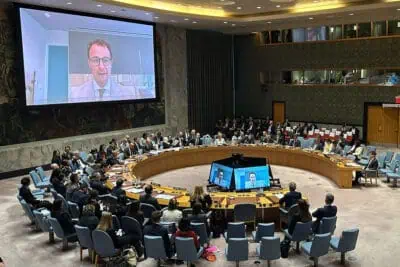
The first reaction by the UN Security Council to the Hamas massacre was marked by division, starting with an emergency session on Oct. 8, held behind closed doors. The members may have verbally condemned the slaughter, but they emerged from the meeting without a statement. Days later, after Israeli’s all-encompassing siege on Gaza began to take its own fatal effect — keeping lifesaving supplies from getting to Palestinian civilians — Russia submitted a draft text to the Council.
It called for an “immediate” humanitarian cease-fire and the release of “all hostages,” among other urgent points. Yet the draft did not mention Hamas’s role instigating the war. That omission sent the resolution to the trash bin, after the US and Britain both condemned the nonreference to the terrorists.
The resolution, voted on by the Council on Oct. 16, drew only five yes votes (it needed nine plus no veto). The four other countries that voted in favor were China, Gabon, Mozambique and the United Arab Emirates. The Russian-led version was also competing with a more comprehensive Brazilian-led draft text, risking its success too. (The draft was slammed by a US veto on Oct. 18 because it did not explicitly state Israel’s right to self-defense, Linda Thomas-Greenfield, the American envoy, said.)
Russia’s credibility at the UN as it flouts international human rights laws in Ukraine was also displayed early this month when it ran for a seat in the Human Rights Council. Russia was booted from the 47-member body in a vote by the UN General Assembly in April 2022 for committing war crimes in Ukraine. In the Oct. 10 election, Russia was running against Albania and Bulgaria for the two open seats in the Eastern European bloc. Russia won 83 votes in the secret balloting by 193 member states, revealing surprisingly strong support for the country, despite its loss.
Richard Gowan, a UN analyst for the International Crisis Group, described Russia’s election results as a “minor success” for President Vladimir Putin.
Despite records being kept by UN human rights organizations and other experts of Russia’s atrocities in Ukraine, there has been no international prosecution of top Russian officials. An international tribunal proposed by Ukrainian President Volodymyr Zelensky, the Baltic countries of Estonia, Latvia and Lithuania as well as Liechtenstein to prosecute the crime of aggression — putting Putin and his highest advisers on trial — has been blocked by the US and Britain, who prefer a hybrid court. Critics contend, however, that it will not be as effective as a pure tribunal in holding war criminals to account.
Russia has also tried to play a dominant role during the current Israeli-Hamas war by requesting the resumption of a General Assembly emergency special session on the “protection of the Palestinian civilian population.” In a letter dated Oct. 18 to the president of the Assembly, Dennis Francis, the seniormost diplomats of the respective UN missions of Russia, Syria and Nicaragua asked for the “urgent resumption” of the 10th emergency session, “given the gravity of the situation in the region of the Middle East. . . .”
Besides Russia’s persistent aggression against Ukrainian civilians, Syria has been torturing its own population for their perceived opposition to President Bashar al-Assad amid its civil war. In Nicaragua, the UN high commissioner for human rights, Volker Turk, said in September 2023 that “perceived critics of the authorities, and their relatives, are routinely harassed, persecuted and jailed.”
Francis, the president of the General Assembly, has set Oct. 26 for the emergency meeting on Palestine. How the US handles the Assembly gathering, where it is holds no veto and is on equal footing among the 193 member states, could show Biden’s strategy to further his re-election campaign in the next year.
Indicatively, Biden’s efforts to frame both “the Israel and Ukraine wars as democracy versus authoritarianism,” Schlesinger said, was clear in his White House speech to Americans on Oct. 19, in which he staked his foreign policy on backing aid to Israel and Ukraine in their respective wars.









There’s an echo of the US war in Vietnam in Washington’s refusal to back a ceasefire in Gaza. It’s clear that Israel has to bomb the Palestinians and the hostages “in order to save them”.