








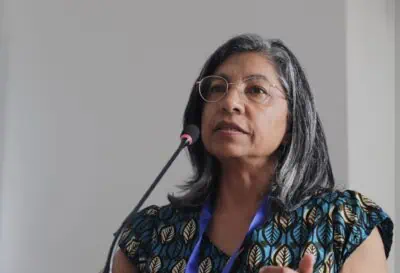
Alice Jill Edwards, the United Nations’ first woman to serve as special rapporteur on torture, is wasting no time in her first year on the job. She has accused the Russian government of systematic torture in Ukraine and called for banning the use and export of “medieval” torture weapons. She is also investigating the mutilation of demonstrators’ eyes in Chile.
“The issues themselves are never-ending, and regrettably since I have started, have grown, mostly linked to the rise in armed conflicts around the world as well as the rise in public protests and growing oppressiveness of even democratic regimes,” Edwards, 51, told PassBlue in an interview in November from her base in Geneva, where she is a research fellow at the Geneva Academy.
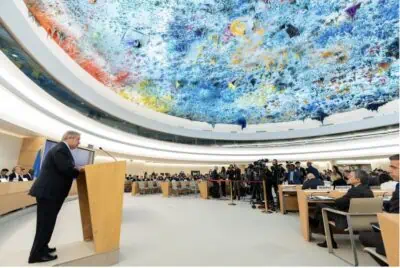
While the UN has been accused of weak leadership for its response to the Russian invasion of Ukraine in 2022 and, more recently, the Israel-Hamas war, Edwards has spoken out against the use of torture, claiming it is increasing and that countries must investigate the rising phenomenon or face accusations of complicity. In her role as special rapporteur, a voluntary assignment from the Human Rights Council, she is independent of the UN system and more free to speak out.
Over the six years of Edwards’ mandate as a special rapporteur, she is hoping to strike a balance between visiting countries emerging from oppressive regimes and those caught up in conflict. She travels with a security officer for protection and a forensic expert who can investigate whether torture has occurred through physical examinations and other professional methods.
She has 25 years’ experience working in human rights advocacy for nongovernmental organizations and the UN. More recently, she has privately encouraged countries to ratify the Convention Against Torture. (The United States, for example, has done so.) Edwards says her diverse experience gives her “an edge” in tackling the torture mandate.
Born in Tasmania, Australia’s least-populous island state, Edwards went on to study law in Britain and France before returning home to complete a Ph.D. in public international law. She has worked with rape victims in Bosnia-Herzegovina and has long argued that rape should qualify as a form of torture.
Edwards spoke with PassBlue about her visit to Ukraine in September; to Chile and Colombia in October; and the role of one of the most influential special rapporteurs in the UN. Edwards spoke about interviewing Russian prison conscripts who had been thrown to the frontline in Ukraine with little training; and the challenges in prosecuting war crimes that have occurred in the country.
“We are living in an era of war, and we’ve lost the art of mediation and compromise and acceptance of each other,” she said.
The interview has been condensed for clarity and space constraints.
PassBlue: Why did you go to Chile?
Edwards: Throughout my six-year term, I would like to tackle areas of allegations of major torture or other inhuman treatment — for that reason Ukraine was in my sights. Then I would like to go to countries that have a broad range of good practices and, for example, Chile, [which] has transitioned from dictatorship to a functioning democracy. . . . It has been 50 years since Chile’s military coup, and there remains serious challenges for justice for victims and survivors of torture and their families from that time. In 2019, a large protest [took place] with a very heavy crackdown that led to 10,000 people being injured by the police, including around 350 people that sustained eye injuries and eye mutilations because of 12-shot rubber pellet guns. But the content of the rubber pellets was actually lead.
This is directly related to my “Torture Tools” report presented to the General Assembly in October, where amongst the list of items [are those] that I consider inherently cruel, inhuman or degrading. Therefore, these kinetic projectile weapons used on [people’s] faces are prohibited under international human rights law. The Chilean government informed me that they have reduced 12-shot weapons to three-shot. I have requested that they go further because even with a three-shot weapon, if you are standing with two friends, or two passers-by, they are going to be struck by those weapons. Now, as a follow-up to the torture report, every country visit I make I will be inspecting their weapons storage and looking at the types of weapons they are using, which I did in a couple of facilities in Chile. I also have discussions with the authorities about everything they have done to ensure that such large numbers of violations in the context of demonstrations don’t happen.
PassBlue: How did your trip to Ukraine come about?
Edwards: I came into my mandate in August 2022, when allegations of torture emerging from the war in Ukraine were escalating. It was important, as the new special rapporteur on torture, that I didn’t shy away from issues that were happening in real time in a war. I went with two main objectives: to look at the investigation and documentation by the Ukrainian authorities of allegations of torture and other similar treatment by Russian forces. I had just completed a Human Rights Council report on the duty to investigate torture, which remains an obligation even in armed conflict, but we’ve never really studied fully how one does that in an armed conflict. In most other contexts around the world, the thought of justice comes well after the conflict has ended, when there is deterioration of evidence, people’s memories fade or a reluctance to come forward because they may be in exile, in asylum or they’ve decided to get on with their lives.


The second objective was to inspect and check on persons who have been detained and deprived of their liberty because of the conflict by the Ukrainians. So that included persons who are alleged to be collaborators with the Russian authorities, as well as Russian prisoners of war. So I went with an objective to also check on the treatment by Ukrainian authorities of Russian prisoners of war. I had received a large submission of allegations of torture ahead of my trip, which I sent to the Russian authorities. So it was also to double-verify the veracity of allegations coming into my mandate.
PassBlue: Were the allegations of torture by Russia coming from the Ukrainian prosecutor’s office?
Edwards: I can’t say the source, but I received over 50 individually named allegations of which I submitted a summary version to the Russian authorities with four individuals named with their consent, to give a picture of the allegations that I was following up on. For torture, once an allegation has been made, there is a duty on the state to investigate. It doesn’t mean that they must proceed to prosecution but they must investigate. They are on notice. So I was also requesting information from the Russian state on what they had done to investigate all the allegations that were coming out of the occupied parts of Ukraine.
PassBlue: Tell me about your trip to Ukraine and where you traveled. Did you feel like you were given full access to what you needed?
Edwards: I did not have access to, for security reasons, the Russian-occupied areas. I did have access to individuals who had been liberated from certain zones and interviewed numerous alleged victims and survivors.
PassBlue: Obviously, there is still a big focus on Russia’s war in Ukraine. Is there anything unique or significant about what’s going on there that’s relevant for the world regarding torture?
Edwards: I think it’s the first international armed conflict we’ve had for a long time where you have a high volume of allegations of torture of the old-fashioned kind. It’s fascinating to me that in the 21st century, we have a violation of the UN Charter, by a UN veto power, coupled with widespread allegations of torture and ill treatment. The documentation I have seen shows a consistency across the methods that have been deployed, the supervisory structures in which the torture is being carried out, as well as the purposes for the torture. I think there is a Russian state policy to use torture for military ends — whether to obtain intelligence, to humiliate and debase the enemy and to keep the community in a state of fear, as well as to punish anyone who has allegedly collaborated with Ukraine. We are talking about the territory of Ukraine, and it is not a criminal offense to collaborate with your own government.
Even though I have called on the Russian authorities, I have not seen directives sent to their troops not to torture — information that I have asked for directly. If you are not going to investigate or prosecute anybody for allegations of torture and you’re not going to put out a statement and make this stop, that is state policy.
PassBlue: Has Russia responded to your letter about torture allegations in Ukraine?
Edwards: Not officially to the letter, that’s all I can say at this stage.
PassBlue: Sexual violence has been a focus for you in the past: did you come across cases of rape and sexual violence committed by either side in the war in Ukraine?
Edwards: One of my objectives was to look into how those allegations are being investigated and documented by the Ukrainian authorities. I think this was one of the more difficult issues to investigate in such a short time. Certainly, I heard several cases of sexual torture against men and of numerous men indicating they had been forced to listen to women screaming and women being sexually tortured.

PassBlue: I understand that you visited Russian POWs in Ukraine. What sense did you get from your interviews as to why people ended up in Ukraine fighting?
Edwards: I was there in September, so the Wagner group was on the demise. I spoke to newly captured Russian soldiers, who hadn’t spent more than two months on the front. They’re being deployed and being captured, at least the cohort who were in the detention facility while I was there. It seemed like they had been released from prison, given two weeks’ training, went on the frontline, were captured and found themselves in a Ukrainian POW camp. Most I spoke with had been recruited by the Russian military or by the Department of Defense, which was a shift from a couple of months before, where there was more recruitment by Wagner.
PassBlue: Were the people that you interviewed imprisoned because they were fighters or had they been accused of certain crimes — why were they being detained?
Edwards: Amongst them are those that are accused of crimes. I think going forward, however, when this armed conflict is resolved, the question about justice will remain an issue. There are some prisoner swaps, and you’re essentially removing people from the territory where they have been accused of committing crimes. The priority for the Ukrainian authorities is to get their soldiers back. That is because they are also worried that they are being subjected to torture, and the evidence suggests that yes, they probably are.
PassBlue: You said that Ukraine has a massive challenge investigating real-time crimes. How are they documenting this?
Edwards: When I was there, the Ukrainian authorities reported to me 103,000 open cases of war crimes. They understood that the massive scale is going to be one of the challenges going forward. My view is that they will need to do a triage of the allegations and prioritize the ones that are the most serious and at the same time have a channel of the most serious that they can action and the most serious that they cannot yet action.
There are also quite a few NGOs and lawyers doing detailed, high-quality interviews with victims in which they’re gathering a very good dossier. I think for the international community that are involved, the cross-contamination by multiple interviews is a real worry. So there’s a single victim of torture being interviewed multiple times by different actors, some for state prosecution and others for NGO advocacy and others for trauma counselling . . . [so] you can end up with a single individual either being retraumatized or providing piecemeal information because they are traumatized, which in the case of torture is common. That eventually can undermine their evidence because they didn’t disclose something the first time they were interviewed and they disclose it subsequently or they disclosed it to a human rights NGO.
The understanding [of] trauma on memory and testimony is absolutely key, and as lawyers we are not trained to take that into account — we are looking for consistency, detail, accuracy of dates, memory recall over a long period of time because the wheels of justice are slow. That is not specific to Ukraine, but because of the amount of actors in Ukraine, I think it’s worth the authorities having a strategy to handle the challenges that might arise.
PassBlue: The final question: Where are you planning to visit in 2024 and what will you be looking into?
Edwards: I can’t say where I am going to be visiting, but my next report to the Human Rights Council is on issues of prison management. That will be followed on issues in police and law enforcement. I’m doing a series of issues leading up to the 40th anniversary of the special rapporteur in 2025.
PassBlue: Will you visit Ukraine again?
Edwards: It’s probable. I have offered assistance to the authorities in follow up to my visit and report. Part of my mandate is to make sure that victims and survivors achieve justice. I think it’s important that the focus is not taken off the conflict in Ukraine, not least for those that are having to live through it but also because the conflict is really unsettling multilateral relations. It is pivotal to the United Nations system, as it was intended to secure international peace and security. Ukraine, of course, is not the only conflict in the world. I’m also following Sudan and the current Israel-Palestine crisis. We are living in an era of war, and we’ve lost the art of mediation and compromise and acceptance of each other.
Due to an editing error, the article has been corrected to reflect that the United States has ratified the Convention Against Torture. The article was also updated to reflect that the second photo of Edwards does not depict her interviewing Russian POWs but Ukrainian detainees.







Dear Pass Blue: The U.S. ratified the Convention against Torture and Other Cruel, Inhuman or Degrading Treatment or Punishment in 1994, and has submitted the requisite Country Report from the U.S. to the Committee against Torture as delineated under the treaty.
Thanks, we made the correction.
Dear Pass Blue,
The United States is a state party to the Convention on Torture. It was signed by President Ronald Reagan and ratified by the US Senate under President Bill Clinton in 1994. It is one of just three of the nine core human rights treaties that the US is party to. The others are the convention against racial discrimination and the civil and political rights convention.
Here is the list of states parties to the Convention on Torture: https://treaties.un.org/Pages/ViewDetails.aspx?src=TREATY&mtdsg_no=IV-9&chapter=4&clang=_en
Thank you for highlighting Ms. Edwards important work.
The Rev. Susan H. Lee, Ph.D.
President, US Women’s Caucus
Thanks so much. The link we used must have been outdated. We will correct the reference. –Editors