








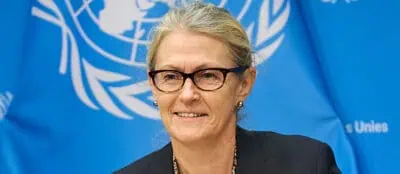
Pramila Patten, the United Nations special representative on sexual violence in conflict, is reportedly going to Israel at the end of January. She was invited by the government to visit the country more than a month ago to hear first-hand testimonies from Israeli survivors of sexual violence allegedly committed during the brutal Hamas and affiliated militia attacks in Israel on Oct. 7.
Patten, according to a press release in early December, had “responded positively” to the initial invitation to visit Israel. But it’s unclear if she will investigate alleged sexual violence and rape that was committed by the militias three months ago.
[Update, Jan. 10: UN spokesperson Stéphane Dujarric told reporters that Patten would conduct a “mission” to Israel and the West Bank at the end of the month “to gather information on sexual violence, reportedly committed in the context of the attacks of 7 October and its aftermath” The mission “will be conducted in the exercise of her mandate, in accordance with her standard UN methodology.” She’ll be accompanied by experts in “safe and ethical interviewing, forensic evidence, digital analysis, and accountability,” but she is not mandated to “investigate”]
Yet in an email to PassBlue on Jan. 9, a spokesperson for Patten declined to confirm Patten’s trip to Israel, saying that “for security reasons, it is our practice that we do not give the dates of the SRSG’s missions.” (SRSG refers to “special representative of the secretary-general.”) On Jan. 12, a follow-up email to Patten’s office seeking more details on the mission went unanswered.
Patten, a 65-year-old lawyer originally from Mauritius, said in another press release, on Dec. 21: “All forms of sexual violence and the taking of hostages are strictly prohibited under international humanitarian and human rights law. Accordingly, all the horrific reports of sexual violence allegedly committed by Hamas on 7 October must be promptly and rigorously investigated, and the United Nations reiterates its readiness to independently investigate any such violations.”
Her invitation to visit Israel comes as the UN continues to be on the receiving end of harsh criticism from Israeli government officials and civil society groups, who accuse the world body of failing to condemn Hamas for its slaughter on southern Israel, in addition to accusing the UN of being too slow to recognize witness accounts of rape and sexual violence that occurred on Oct. 7. First-hand accounts from Israeli women on instances of rape and sexual violence have yet to surface publicly.
“The UN, an organization that remains silent when babies are taken hostage and women are viciously raped has become an accomplice of terrorists,” Gilad Erdan, Israel’s ambassador to the UN, said in his remarks to the General Assembly on Jan. 9. “And if the UN is an accomplice to terrorist, it has no justification to exist.”
The Assembly was debating a veto cast by the United States in the Security Council on Dec. 22 over a Russian-proposed amendment to a ceasefire resolution in Gaza. (The US abstained in the final vote on the resolution.)
“Hamas Nazis viciously raped Israeli women before executing them and use sexual violence as a weapon of war,” Erdan said. “But here at the UN, the body that supposedly represents the bastion of human rights? Silence. Silence. Israeli women are not women and Israeli children are not children.”
The role of investigating sexual abuse and rape by the UN falls to the independent Commission of Inquiry on the Occupation Palestinian Territory, including East Jerusalem, and Israel, which was established by the Human Rights Council in 2021. The commission announced on Nov. 29 that in addition to investigating war crimes committed by Israel and Hamas, it will focus on accusations of sexual violence committed by Hamas.


As PassBlue previously reported, Navi Pillay, chair of the commission and a former UN high commissioner for human rights, told PassBlue that the commission was “cooperating closely” with UN Women and the prosecutor of the International Criminal Court (ICC) on allegations of sexual crimes. She said the commission has made “a call for submissions and sent yet another request to the Israeli authorities for access to investigate the allegations of crimes including sexual violence in Israel.” (An initial request was announced by Pillay on Oct. 24.) She has visited Israel and Palestine in the past, in 2011, as the high commissioner for human rights.
In an email to PassBlue on Jan. 9, the ICC prosecutor’s office confirmed that the court was also “investigating gender-based crimes in the situation of Palestine, including those alleged to have occurred in Israel and Gaza, on and after the 7th of October 2023.”
Still, a possible challenge for any UN-led investigation may be Israel’s willingness to cooperate. After the commission’s investigation announcement, Erdan quickly responded on X, tweeting: “Israel has zero trust” in the “antisemitic Commission of Inquiry.”
He added, “Israel will not cooperate in any way with such a discriminatory and antisemitic body.”
In an email to PassBlue on Jan. 5, the office of Volker Turk, the UN high commissioner for human rights (OHCHR), said that he had “made repeated requests, in writing and orally” for the Israeli government to grant access to enable his office “to undertake most effectively the tasks associated with [Turk’s] mandate — including comprehensive investigation of human rights violations that have taken place both in Israel and the Occupied Palestinian Territory, notably from 7 October 2023 onwards.”
His office said their requests “have not received response to date.”
In the same email to PassBlue, a spokesperson clarified that the UN Human Rights Office, as it’s commonly called, uses strict standards to gather and assess information “which is then analysed against international law.” Based on their findings, the office makes “recommendations to the relevant parties to take appropriate actions on any violations or abuses that are found to have occurred.” If requested, the information gathered can be provided to “other UN entities or accountability mechanisms such as the ICC.”
In recent weeks, several reports — including claims of sexual violence and rape committed by Hamas on Oct. 7 in Israel — have flooded mainstream media outlets. However, some findings have been questioned. The most notable was a two-month-long investigation published by The New York Times on Dec. 28, 2023, that contends, through the vetting of “video footage, photographs, GPS data from mobile phones and interviews with more than 150 people, including witnesses, medical personnel, soldiers and rape counselors” to have “uncovered new details showing a pattern of rape, mutilation and extreme brutality against [Israeli] women [by Hamas] in the attacks on Israel.”
Shortly after publication, however, Mondoweiss, an independent media outlet that follows “developments in Israel/Palestine and related US foreign policy,” refuted the Times article after reporting that sources were interviewed for the article “under false pretenses” and that the investigation provided no new or credible evidence of rape but rather repeated secondhand testimonies from witnesses who said they saw acts of sexual violence and who had previously been quoted in other mainstream media, including The Washington Post, PBS News Hour, CNN and in earlier articles published in The Times.
Claims of evidence of rape reported in The Times have also been refuted by the Electronic Intifada, an online media outlet that focuses on Palestine.
Moreover, CNN’s Jake Tapper recently interviewed Raz Cohen, a 24-year-old Nova music-festival attendee who besides being quoted in The Times investigation, says he witnessed a rape while hiding behind a bush from Hamas, on Oct. 7. Tapper introduced Cohen on the program as someone who witnessed sexual violence and rape committed by Hamas, yet in his testimony, Cohen tries to clarify that he did not see Nukhba soldiers — a special forces unit in the Qassam brigades, the military arm of Hamas — committing the alleged rape but instead they were “normal civilians.”
“It was the regular people from Gaza with the normal clothes,” Cohen said. Tapper did not address Cohen’s clarification further. Notably in The Times investigation, Cohen also refers to the perpetrators as “men wearing civilian clothes.”
Other accounts from Oct. 7 that have been published by media outlets as credible evidence of sexual violence have also been questioned as some witness testimonies have, over time, revealed inconsistencies. Yet in such instances of trauma and memory recall, experts say discrepancies are not uncommon.
One example is Rami Shmuel, a producer of the Nova music festival, who in a video published by Israel’s Foreign Affairs Ministry said he saw with “his own eyes” a woman stripped out of her clothes. He says “they spread her legs” and that after “they done what they done” they “executed her,” referring to Hamas militants. However, in a separate interview with Sky News, Shmuel never mentions witnessing a rape but rather recalls finding girls who looked as though they had been raped and tortured when he returned to the music festival grounds after the deadly Hamas attack.
The Israeli police are also conducting their own investigations into claims of sexual violence and rape on Oct. 7 by Hamas. However, in an article published in Haaretz, on Jan. 4, Adi Edri, a superintendent tasked with investigating sexual assaults committed on Oct. 7 in Israel, said that in addition to a lack of forensic evidence the investigators have not yet interviewed or identified any women who were victims of sexual assault or rape. In the few cases where authorities say they have “amassed testimony” of sexual assaults by Hamas, they also admit that they have not “yet been able to identify the specific victims of the acts to which witnesses have testified.”
“I have circumstantial evidence,” Edri told Haaretz, adding that at “this stage, I have no specific bodies.”









Just amazing bias. It is confounding that American man get cancelled for just looking at a woman the wrong way, yet Israeli women need multiple forensic evidence before the biased UN and it’s supposed observers believe. What happened to believe the women?
While I can’t comment on the mandate of UN agencies to investigate Israel’s claims against Hamas of sexual violence committed on Oct. 7 (or the likelihood of a successful outcome), I deeply question some statements and sources in the article, challenging such claims:
“In recent weeks, several reports — including claims of sexual violence and rape committed by Hamas on Oct. 7 in Israel — have flooded mainstream media outlets. However, some findings have been questioned.”
She then goes on to quote “two independent media outlets” — Mondoweiss and Electronic Intifada, that challenge the Times’ claims. While Mondoweiss may have been founded by established journalists, their stories on the conflict are shockingly one-sided against Israel — one of their articles is even titled, “I could have been one of those who broke through the siege on October 7,” where the author applauds the “determination and courage of those young people who returned to their land on October 7.” Electronic Intifada, by its name alone (Intifada = armed uprising in Arabic), clearly displays its anti-Israel bias.
Even more upsetting is the article’s questioning of an interview that CNN’s Jake Tapper conducted with an Israeli man who survived the Oct. 7 massacre and reported witnessing women being raped. “Cohen tries to clarify that he did not see Nukhba soldiers — a special forces unit in the Qassam brigades, the military arm of Hamas — committing the alleged rape but instead they were “normal civilians.” In the Times investigation, Cohen also refers to the perpetrators as “men wearing civilian clothes.”
The article misses the whole point, the terrorists and supposed “civilians” who entered southern Israel were one and the same, whether they were ordinary Gazans who decided to join in the raping and pillaging or Hamas soldiers wearing civilian clothes. Everyone knows Hamas operates freely among the civilian population and even uses them as human shields.
Finally, the reporter’s quoting of the Ha’aretz article is very misleading. She refers to Adi Edri, a superintendent tasked with investigating sexual assaults committed on Oct. 7 in Israel, who said that in addition to a lack of forensic evidence the investigators have not yet interviewed or identified any women who were victims of sexual assault or rape. “I have circumstantial evidence,” Edri told Haaretz, adding that at “this stage, I have no specific bodies.”
That is simply because there are few if ANY survivors of the Oct. 7 rapes — most were brutally murdered afterward and buried very quickly because of the constraints of Jewish law, which the NYT acknowledges. In addition to the Times’ account, I have read others that state the few women who may have survived are simply too traumatized to speak at this time, and I can hardly blame them. Some of the released female hostages have also given testimony that Hamas is continuing to sexually abuse the women in captivity – among the over 100 hostages that remain in Gaza — and Hamas even published a video of four teenage girls with bloodied faces shortly after their abduction.
Have we not learned the lessons of the #MeToo movement in bringing sexual assault awareness to the forefront, or does this standard simply not apply to Israeli women and girls?
Thank you for your thoughtful comments. We appreciate your response on such a difficult matter. Our reporter has done a thorough job and we stand behind her work. — Editors
The prevalence of gender-based violence is also relevant for peace research, says Austrian sociologist Franz Jedlicka. His “culture of violence scale” can help to predict armed conflict through estimating the acceptance of violence that persists already within a society.
Lorraine
There were rapes. The evidence I have seen is pretty clear. It does not come from the NYT, but from entities that collected it on site, under difficult and traumatic circumstances. See here:
https://www.phr.org.il/wp-content/uploads/2023/11/5771_Sexual_Violence_paper_Eng-final.pdf
Also interesting analysis of the general dynamic around this issue here:
https://theintercept.com/2023/12/24/feminism-sexual-violence-hamas-israel/
I am appalled by the war crimes/ crimes against humanity committed by the Israeli government and the IDF in Gaza, but that does not mean Israeli women were not raped. The “woman in the black dress”, the case that now is so controversial, is not the only one.
Thanks for the intercept link – pity this did not get out to mainstream – it was sad to see UN Women trashed for political points. The interesting thing is we all know that very few care about rape as a weapon of war in developing countries that happens every single day – are they jumping up and down about UN women’s “lack of action” in these cases. Absolutely not. The (mis) use of media by backers with money in the Israel/Gaza case has been eye opening to say the least.
Agreed!