








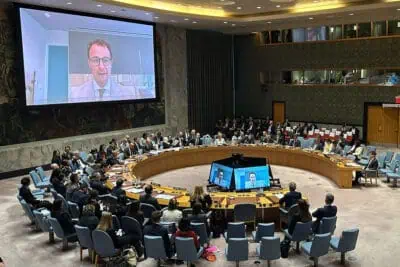
President Joseph Biden’s address to the 2024 UN General Assembly — his final one as United States leader — represents a summary of what he regards as the highlights of his foreign policy, where, he argues, that his four years in office have helped leave the world in a better condition.
Biden, 81, a multilateralist in the tradition of past liberal Democratic presidents like Franklin Roosevelt, Harry Truman, John Kennedy, Jimmy Carter, Bill Clinton and Barack Obama, emphasized in his remarks from the outset how his administration has vigorously displayed its commitments to the UN Charter, most importantly by helping Ukraine defend itself against Russia’s cruel, illegal invasion.
But he broadened the scope of that commitment, checking off a list of his primary priorities for the UN to which the US has contributed vast sums of money — on global health, food insecurity, drought, trade and technology, norms on cyberspace, an Indo-Pacific security framework, supply chains, debt forgiveness, human rights and terrorism.
One interesting addition to this roster of progressive initiatives is a global minimum tax on corporations, an idea that the UN General Assembly recently adopted.
On the wider matter of the UN’s responsibility for maintaining peace and security, Biden noted his attempts to negotiate an ending to the disputes in Venezuela, Haiti and Yemen, although, oddly, he scarcely mentioned settling the Gaza imbroglio except to say that he continues to want peace talks and a two-state solution, without explaining how he might reach either of these goals.
Nor did he apologize for the numerous US vetoes in the Security Council demanding a ceasefire in Gaza since the Hamas attack on southern Israel on Oct. 7. On China, he barely referred to the global power except to restate official policy — that the US does not seek conflict with Beijing and abides by the “one-China” policy regarding Taiwan. Lastly, on nuclear matters, he criticized Russia, China, North Korea and Iran over their troubling machinations with such dangerous weaponry.
He quoted parts of William Butler Yeats’s “The Second Coming,” while paraphrasing it as well. “In 1919, the Irish poet William Butler Yeats described a world, and I quote, where ‘Things fall apart; the centre cannot hold; Mere anarchy is loosed upon the world,’ end of quote.”
In his own words, he went on, saying: “Our task, our test is to make sure that the forces holding us together are stronger than those that are pulling us apart, that the principles of partnership that we came here each year to uphold can withstand the challenges, that the center holds once again.”

In sum, Biden was not at the UN to present new policies. He was there to pointedly remind the planet of the lasting nature of the UN Charter — and America’s compliance with it. While he might have alluded to the fact that the US under President Roosevelt was responsible for originating and nurturing the idea of the UN, he pointed often to the values and ideals of not only the Charter but also to the Universal Declaration of Human Rights for humankind. The latter document was championed primarily by Eleanor Roosevelt in 1948.
The goal of Biden’s final speech as president, then, was not to present fresh ideas about Ukraine, Sudan, Gaza or other conflict zones around our earth. Nor did he wish to upbraid the UN over its inability to act in many of these wars. There may have been election-year reasons for his silences, including not wishing to create problems for Kamala Harris.
His speech, in short, changes nothing in American international policy. But it represents his efforts to remind Americans of the importance of the UN in curtailing the turmoil in the world and bringing about the ideal vistas that we all seek in our lives.
His farewell may also be a chance for Biden to leave some markers for future US presidents.












Biden is leaving behind a UN which is in shamble and a UN Security Council which has lost credibility, respect and leadership around the world because of its P5 members’ actions and decisions. Unfortunately he will be remembered as genocide Joe in the history of humanity. May I add that he has abandoned the Afghan women and girls in the hands of the Talibans? I am sorry but there is no other way to describe the man and his legacy!
Dr. Camara,
I tend to disagree with you about the organization of the UN and what President Biden is leaving behind. Although, I do understand your point of view. Humanity on this planet requires a strong leader that has the skills to manage, lead, organize, and knows how to balance the powers. Secretary-General Guterres has these skills and if one of the countries is not contributing to world peace in some way, they should seek assistance from the UN. It is the UN’s responsibility to maintain peace as best it could. If the UN has this negative reputation, it is only because world leaders are not cooperating with the UN and it’s policies. They can only do the best they can with the resources they have. Please let’s always keep this in mind. Different cultures around the world adhere to different values and principles and we may not be able to change them, but we need to respect them. We are not abandoning women and girls around the world from these different cultures that don’t adhere to maybe your values and principles – they will always be in the radar of the UN. We can only pray that the Taliban knows the differences. This would be a huge step in the right direction of cultural understanding between the Taliban and other countries.
Ilona J. Torraca, Ph.D. Candidate in Public Policy & Administration, Walden University