UK: Calls for Ceasefires in Mideast; Silence on Israeli Atrocities
Keir Starmer, Britain’s prime minister as of July 5 and a former human rights lawyer, says ceasefires among Israel, Hezbollah and Gaza are needed to stop the “rising tide”of conflict in the Mideast. Starmer said that diplomacy, releasing the hostages kidnapped by Hamas on Oct. 7 and an unfettered flow of humanitarian goods into Gaza are short-term necessities.
Yet, he made no mention of the documented human right abuses by Israel in its war in Gaza and its dismissing the International Court of Justice advisory opinion that Israel’s decades-long occupation of Palestinian territory is illegal.
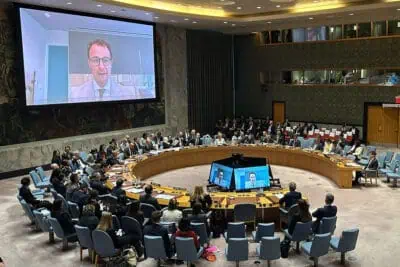
Starmer, 62, delivered his maiden speech to the United Nations General Assembly on Sept. 26.
Britain has been equivocal in its stance on the Gaza war. “Our view is that Israel’s actions in Gaza cannot be described as a genocide, which is why we thought South Africa’s decision to bring the case was wrong and provocative,” a Jan. 27, 2024 statement from its Foreign and Common Wealth Development Office read. It was responding to South Africa’s case accusing Israel of committing genocide that it submitted to the International Court of Justice.
While Starmer was in the opposition Labour Party at the time, it backed calls for a “sustainable ceasefire” and humanitarian pauses. The ceasefire was contingent on Hamas being demobilized as a body capable of launching attacks on Israel.
In May, Karim Khan, a British lawyer who is chief prosecutor for the International Criminal Court, and his team filed motions to the court’s judges to issue an arrest warrant for Yoav Gallant, Israel’s minister of defense, and Benjamin Netanyahu, the country’s prime minister, along with three Hamas leaders.
Starmer’s immediate predecessor, Rishi Sunak, a member of the Conservative Party, described the warrants as “unhelpful.” The UK condemned Israel’s forced displacement — a war crime — of Palestinians in the Gaza region of Rafah, and issued visa bans to extremist Israeli settlers in the West Bank as well.
“The world cannot look away,” Starmer said at the UN on Sept. 26. “And we must stand up for international law.”
Promising to stand by its support for Ukraine’s military defense against Russia and calling for an end to conflict in numerous other hotspots, Starmer said he must deliver on his mandate to Britain by taking an active role in international development.
” . . . we recognize that our success in Britain can never be separated from events beyond our shores,” he said. “Global challenges rebound on us at home. And to grapple only with the effects of war, poverty, climate change, pandemics or irregular migration when they arrive on our doorstep is to set ourselves up to fail.”
His country, Starmer added, supports reforms to expand the Security Council. “We want to see permanent African representation on the Council, Brazil, India, Japan and Germany as permanent members, and more seats for elected members as well.” The UK is a permanent member of the Council.
Additionally, he said, “We will use our seat on the boards of the IMF [International Monetary Fund] and World Bank to argue for a bolder approach, to tackle unsustainable debt which is compounding poverty and inequality, depriving the sick of health care and children of education.”


Starmer concluded by saying that the UK will be “moving from the paternalism of the past towards partnership for the future.” — DAMILOLA BANJO

China: Pushing Its ‘Group of Friends for Peace’ in Ukraine
Chinese Foreign Minister Wang Yi told the General Assembly on Saturday that Beijing’s joint Ukraine peace initiative with Brazil — which has been vehemently rejected by President Volodymyr Zelensky — was “constructive” and based on the UN’s own principles.
“An end to the Ukraine crisis remains elusive,” Wang, 70, said on Day 5 of the General Assembly’s high-level week. “The top priority is to commit to no expansion of the battlefield, no escalation of fighting and no provocation by any party and push for de-escalation of the situation as soon as possible.”
China and Brazil, which are grouped in the BRICS bloc with Russia, India, South Africa, Egypt, Ethiopia, Iran and the United Arab Emirates, issued their six-point peace plan in May and have since been seeking support for it from other global South countries.
“China is committed to playing a constructive role, engaging in shuttle mediation and promoting talks for peace, not throwing oil on the fire or exploiting the situation for selfish gains,” Wang said.
He continued: “At this session of the General Assembly, China, Brazil and other countries in the global South have jointly launched the ‘group of friends for peace.’ Its very purpose is to uphold the principles and purposes of the UN Charter, build consensus for a settlement of the crisis and contribute to a prospect of peace.” (The group issued a communiqué on Sept. 27.)
The China-Brazil proposal envisages an international peace conference “that is recognized by both Russia and Ukraine, with equal participation of all parties as well as fair discussion of all peace plans.”
But in his speech to the Assembly earlier this week, Zelensky angrily dismissed the initiative, saying proposals for “alternatives, half-hearted settlement plans, so-called sets of principles” played into the hands of Russian President Vladimir Putin, whose full-scale invasion of Ukraine occurred in February 2022.
Wang held talks in New York on Sept. 27 with United States Secretary of State Antony Blinken, who said afterward that the Chinese peace proposal “doesn’t add up.” Blinken noted that many of Russia’s weapons relied on Chinese components.
On human rights, Wang said in his speech in the Assembly Hall that Beijing — which has been severely criticized for its treatment of the Uighur Muslim minority in the northwestern region of Xinjiang — would brook no interference in its “internal affairs.”
“China maintains that all countries’ right to independently choose their path of human rights development should be respected,” he said. “No country should impose its own will on others or interfere in others’ internal affairs in the name of human rights. In human rights protection, China is committed to putting people first and promoting the free and well-rounded development of the people.
We have found a path of human rights development that suits China’s national conditions.”
Wang’s speech on Saturday came on the 10th anniversary of the start of the “umbrella revolution” in Hong Kong, when residents of the former British colony demonstrated for the right to pick their own leaders. China had demanded its government approve all candidates.
In his remarks, Wang emphasized China’s drive to develop a multipolar world in which countries of the global South played an equal role.
“We should respect each other as equals. . . . As a large number of global South nations are growing with a strong momentum, gone are the days when one or two major powers call the shots on everything. We should advocate an equal and orderly multipolar world and see that all countries have their own place.” — ANTON FERREIRA

Mali: Praise for Sahelian Group; Scorn for Algeria, Ukraine, Ecowas and France
Malian Deputy Prime Minister Abdoulaye Maïga praised what he qualified as successes of the country’s military government, including the establishment of the Association of Sahel States, known by its French acronym AES. Besides Mali, it is composed of the fellow military governments of Burkina Faso and Niger.
In his remarks to the General Assembly on Sept. 28, Maïga, 43, said that “the government of Mali has a comprehensive, integrated strategy with the goal of restoring the authority of the state throughout the national territory.”
He then delved into denouncing “the support of the Ukrainian authorities for international terrorism”; “France’s involvement in the promotion of three forms of terrorism in the Sahel: armed terrorism, economic terrorism and media terrorism”; and “the fierce hostility . . . from certain officials of Ecowas who are acting on the orders of imperialist and neocolonial entities.” (Ecowas stands for the Economic Community of West African States.)
Maïga reserved his harshest criticism for the Algerian foreign affairs minister, Ahmed Attaf, and the country’s permanent representative to the UN, Amar Bendjama. Attaf has lamented the end of the 2015 Algiers Accords between separatist Tuareg rebels and the Malian government in 2024; Bendjama criticized a Malian drone attack that killed civilians. (Algeria is currently an elected member of the UN Security Council.)
“The accord is dead and gone, and you, you will not be able to resurrect it,” Maïga said. “For every word employed against us, we will reciprocate. Don’t say we didn’t warn you. As for the Algerian permanent representative, in addition to providing room and board and succulent dishes like shakshuka and chorba for fugitive terrorists and renegades, his role as go-between does little to promote neighborly relations.”
The fault-finding from Maïga echoed his previous UN General Assembly addresses. In 2022, he lashed out at the heads of state of Guinea-Bissau, Niger and Côte d’Ivoire, while saying that France supported terrorists and that the country “stabbed us in the back.”
Maïga said that since the military took power in Mali in 2021, “terrorist groups have been seriously weakened, and defense and security are deployed throughout the country.” In November 2023, Malian forces, boosted by the Russian Wagner Group mercenaries, recaptured the northern city of Kidal from separatist Malian Tuareg rebels who had held it since 2012 and had often fought alongside the Al Qaeda-aligned JNIM group.
However, terrorist groups like JNIM have gained strength in other parts of the country as Mali has been concentrating its forces in the far north. On Sept. 20, JNIM attacked an academy for military police and the international airport in Mali’s capital Bamako, killing 70 people, injuring 200 and setting fire to the country’s presidential jet. — DULCIE LEIMBACH