




Welcome back to This Week @UN: Nigeria eyes the Security Council; Mideast wars overshadow women’s rights; Burkina Faso lashes out; Israel bans Guterres. Plus: Lebanon; Yemen; Israel; Iran; Gaza; Haiti.
Follow us on Twitter (X), Facebook, Instagram and LinkedIn.
• Our #1 story this week: Special Report: US to Pressure UAE to Stop Backing RSF Rebels, Sudan Leader Says, by Joe Penney and Damilola Banjo
• #1 story this month: Is This the Peace Plan for Israel and Palestine That Will Work?, op-ed by Mona Ali Khalil
• We thank the tremendous generosity of the Pinkerton Foundation for its recent donation to PassBlue to help us cover our expenses from reporting on the UN General Assembly high-level week. What a boost for our coffers and morale! We also thank another generous donation from a longstanding supporter in Chicago for her continued gift-giving and kindness. We may still be recovering from the toll of UNGA79, chasing scoops while savoring Meryl Streep’s stunning remarks about the sorrows of Afghan women, but we remain steadfast as truth-seekers. — Many thanks, PassBlue’s team
• Ukraine’s envoy to the UN, Sergiy Kyslytsya, is reportedly being considered for the post of first deputy foreign minister in the Ministry of Foreign Affairs, but the Ukrainian delegation here declined to confirm the news.
From PassBlue this week:
• Nigeria Claims It Should Get a UN Security Council Permanent Seat, by Joe Penney
• Swiss to Spotlight Women’s Rights, but Mideast Wars Will Control the Agenda, by Damilola Banjo
• UNGA79: Special Report: Burkina Faso’s Harsh Words for the UN but Praise for Itself, by Clair MacDougall
• A Trip to Israel by UN’s Boss Is Normal. Now the Current Secretary-General Is Banned, by Evelyn Leopold

Top UN news:
Monday, Sept. 30
• Spokesperson’s briefing: Secretary-General António Guterres reiterated his call for “de-escalation, a cessation of hostilities” and full implementation of Security Council Resolution 1701, following Israel’s attacks in Lebanon on Sept. 29. He said that rocket fire from both sides of the Blue Line (the border between Israel and Lebanon) is impeding UN peacekeepers in Lebanon (Unifil), from doing their mandated patrols, although the mission remains in its “area of responsibility,” and its force commander, Lieut. Gen. Aroldo Lázaro, “continues to be in touch with the Lebanese Armed Forces, with the Israeli Defence Forces.” By staying put, the UN peacekeepers are trying to prevent a full-scale ground invasion by Israel.
Spokesperson Stéphane Dujarric also noted the UN’s “concern” over Yemeni Houthis’ missile and drone attacks on the Israeli cities of Tel Aviv and Ashkelon on Sept. 27 and Israel’s retaliatory airstrikes on Sept. 29 on the Houthi-controlled Hodeidah port. (On Oct. 1, Dujarric said that it remains “operational.”)
[Update, Oct. 4: The Irish Times reported that the Israel Defense Forces “has told Ireland to remove its peacekeepers from an outpost on the border with Lebanon as its invasion of the country continues.” Unifil has told Israel it will not be removing the troops]
Tuesday, Oct. 1
• Spokesperson’s briefing: In response to Israel launching a ground incursion into southern Lebanon on Oct. 1, Guterres said that an “all-out war must be avoided in Lebanon at all costs, . . . and the territorial integrity of Lebanon must be respected.” Dujarric said Unifil peacekeepers “remain in position” along the Blue Line, but that “sometimes, if the fighting goes to a certain phase, they do have to go into shelter.” (For more details, see peacekeeping item on Oct. 3.)

Wednesday, Oct. 2
• Spokesperson’s briefing: Guterres further condemned the “broadening of the Middle East conflict,” after Iran fired approximately 200 ballistic missiles toward Israel on Oct. 1 in retaliation for its assassination of Hezbollah leader Hassan Nasrallah on Sept. 27. “This must stop,” Guterres said in a brief statement. “We absolutely need a ceasefire.” Israeli Foreign Minister Israel Katz reacted to Guterres’s lack of specific condemnation for Iran by declaring him a persona non grata. Dujarric said this was the first such instance he’d seen in 24 years of a UN leader being banned from a country. (See our Oct. 3 story for more details.)
• Magdalena Sepúlveda Carmona of Chile is named the new director of the UN Research Institute for Social Development (UNRISD).
Thursday, Oct. 3
• Spokesperson’s briefing: Dujarric said the Office for the Coordination of Humanitarian Affairs (OCHA) is “very concerned” about the “toll of repeated airstrikes on shelters for displaced people” in Gaza, with at least six schools serving as shelters being hit in recent days, including a strike from “Israel fire” on the Al Amal Institute for Orphans in Gaza City on Oct. 3. With the world’s focus shifting toward the escalating conflict among Israel, Lebanon and Iran, the UN is “continuously doing our best to keep every humanitarian crisis in the world up-front and center,” Dujarric said. “That’s our job.”
• Jean-Pierre Lacroix, UN peacekeeping chief, briefed the media regarding Unifil’s status in southern Lebanon amid the recent ground invasion by Israel, saying, in part, “The peacekeepers are currently staying in their position, all of them, and we’re extremely grateful to them, and also extremely grateful to the troop contributing countries.”

Friday, Oct. 4
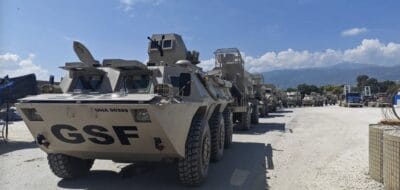
• Spokesperson’s briefing: Guterres “strongly condemns” an attack by armed gangs in Pont-Sondé, in Haiti’s Artibonite department, leaving “several dozen people dead, including women and children” (reports say at least 70 people), injuring “many more” and displacing at least 3,000 people. Guterres highlighted the need for support of the joint work by the Haitian National Police and the UN-endorsed security support mission to curb the spread of gang violence from the capital of Port-au-Prince to other parts of Haiti, urging other countries to ensure the mission “receives the financial and logistical assistance they need in order to succeed.”
The Kenyan-led mission was just renewed by the UN Security Council for another year, but efforts by Council members United States and Ecuador to transition the mission to a UN peacekeeping force are meeting resistance by Russia and China, diplomats say. It is unclear if the UN itself is fully on board with the possibility.