










Britain’s first outing with the media as it takes on the monthly presidency of the United Nations Security Council reflected the country’s shift in rhetoric on Gaza. Experts say, however, that the UK’s Western alliance would trump the government’s historical promotion of human rights.
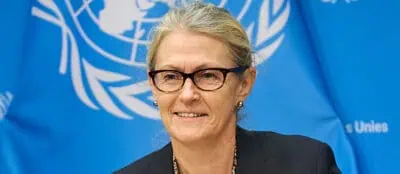
Barbara Woodward, Britain’s permanent representative to the UN, 63, outlined her country’s Security Council focus for November at a briefing to journalists on Nov. 1. During her 55-minute engagement with the press, she notably avoided the well-too-familiar mantra — Israel’s right to defend itself — that President Benjamin Netanyahu and his allies use to justify the yearlong military operation in Gaza.
A UN human rights specialist recently said the Israeli assault is being carried out with genocidal intent. According to the Gaza health ministry, 43,061 people have been killed in the war so far in the enclave.
Although Britain and other Western nations rightly condemned Hamas’s Oct. 7 attack, they still hesitate to directly criticize Israel’s military attacks in Gaza, including the indiscriminate killing of tens of thousands of women, children and elderly people and, particularly this month and in October, a tightening humanitarian siege in Gaza’s north.
The UK has abstained from votes on numerous key Security Council resolutions demanding a ceasefire or improving humanitarian aid flow into Gaza since the Oct. 7 massacre. (The UK, a permanent member of the Council, also voted no with France, Japan and the US against a Russian-led resolution calling for an immediate humanitarian ceasefire. It failed because it did not have nine affirmative votes necessary to pass a resolution.)
Additionally, the country abstained from a General Assembly resolution endorsing an advisory opinion of the International Court of Justice that Israel must withdraw from the occupied Palestinian territories.
“I recognize that there is a very long history,” Woodward said when quizzed by reporters on Nov. 1 about her country’s position on Gaza. “My interventions in the Council are usually three or three and a half minutes, and I think we have to focus on the particular issue of the day, that’s why we start with October 7.”
Woodward condemned last week’s Israeli legislation banning the operations of the UN’s Palestinian refugee entity, UNRWA, from working in Israel and the occupied territories. Experts told PassBlue that the UK warning represents a marked shift from the country’s earlier rhetoric since Oct. 7.
“This week’s Israeli Knesset bills restricting UNRWA’s ability to work are totally wrong,” Woodward said. “There is no justification for denying civilians access to basic aid, and there is no one but UNRWA that can deliver aid on the enormous scale that is now required in Gaza and the region, and no amount of rhetoric can change that.”
Britain was among 17 countries (plus the European Union) that withheld funding to UNRWA after Israel claimed — without providing underlying evidence — that 12 staffers of the Palestinian refugee entity were part of the Hamas-led onslaught in southern Israel. (Two of the UN personnel were already dead.) The UK withheld funding even after an independent review and a separate UN investigation exonerated most of the alleged UNRWA staff.
However, Britain resumed funding of $21 million on July 19, a few weeks after Labour Party’s Keir Starmer became prime minister. (The United States has not reinstated its contribution of $343 million to the agency.)


Britain’s central-left-leaning political party reclaimed the leadership of 10 Downing Street on July 4, ending the 14-year rule of the Conservative Party.
Since taking office, Labour has tempered the UK’s support for Israel. On Oct. 29, Woodward said in the Security Council about Israel’s continued massive bombing of critical infrastructure in Gaza, such as hospitals: “As my Prime Minister has said, the world will not tolerate any more excuses from Israel on humanitarian assistance.”
The new government rescinded its objection to the International Criminal Court’s right to issue arrest warrants for Netanyahu and his defense minister, Yoav Gallant. Britain, as a member of the court, is now bound to enforce its order if it issues an arrest warrant against the two Israeli leaders.
British Foreign Secretary David Lammy also announced on Sept. 2 the suspension of 30 weapons export licenses, out of about 350, to Israel. He told the UK parliament that “there exists a clear risk that they [the arms] might be used to commit or facilitate a serious violation of international humanitarian law.”
Eduardo Albrecht, a senior fellow at the United Nations University Center for Policy Research (UNUCPR), in New York City, said that despite these welcome developments, it is unclear whether the British government’s geopolitical shift will produce tangible policy change toward Gaza or substantially influence the direction of that and other international conflicts. The Labour Party’s historical upholding of human rights ideals would be encumbered by Western alignments, which is a higher priority, he said.
“Previous Labor governments have certainly been more diplomatically nuanced than conservative governments . . . however, this can only happen within the boundaries of a unified Western response,” Albrecht added.
The tiptoeing between Woodward’s new government’s ties to its human rights ideology and to the West — primarily the US and Europe — is perhaps more obvious in the disapproval that has trailed the UK since it suspended only 30 weapons licenses. Critics say that the UK must also ban the export of components of F-35 fighter jets to Israel through third parties.
Lammy has argued that the ban was applied only to offensive weapons, adding that further restricting the British-made F-35 parts to Israel through third parties could “ground planes that are saving lives in other theatres.”
The US remains the biggest military funder of Israel, providing at least $12.5 billion in aid toward its current conflict in Gaza. The relationship has been intensely scrutinized in light of massive casualties caused by US weapons used by Israel retaliating against Hamas in the Palestinian enclave. The matter of weapons flows to Israel has now been taken up by Türkiye, which sent a letter signed by 52 other countries to the UN Security Council on Nov. 1, calling for an embargo.
Woodward told reporters that the UK has no intention of placing a full weapons embargo on Israel.
“The UK has a very carefully monitored and transparent program of arms exports to Israel,” she said. “We cut 30 items from that program, and Israel responded quite vociferously to that cut in arms exports. Further action remains under review; we don’t have an arms embargo at the moment, but we have cut our arms exports to Israel bilaterally.”
Patrick Wintour, the diplomatic editor for The Guardian, told PassBlue that the UK cannot call for an arms embargo against Israel as it would risk its relationship with the US. Only the US can “pull the plug” on arms for Israel, he said, adding that Britain can go only so far without scuttling its alliance with the US.
“They can’t afford to lose the American relationship,” Wintour said. “So, there will have to be a lot of biting of tongues by the UK. There’s an awareness also that they can only take human rights so far in the modern world. [Britain] can’t dispense with all allies and insist on a human rights pedestal that’s of a higher level than anyone else.”
Each month, PassBlue profiles UN ambassadors as they step into the role of Security Council president, but the UK declined to be interviewed for this column, representing a shift since 2018. We instead spoke with experts to provide context about the country’s focus on the Gaza war as it leads the Council in November.
Because of an editing error, the article was corrected to read that the UK voted no against a Russian-led draft resolution in the Security Council. It did not use its veto.













Important focus. I find the Wintour quote digusting. Why emphasize this caution? It’s herdthink. The UK must endure tension with Trump Administration. Europeans will receive no respect unless you stand strong.
Also this phrase “without scuffling its alliance” doesn’t make sense. Do you mean “scuttling”?
UK continues to appease Netanyahu in his unlawful, cruel and deadly conduct in Gaza, other occupied Palestinian territory, in Lebanon, and elsewhere. This emboldens Netanyahu in his defiance of UN and abuse of its Secretary General.