








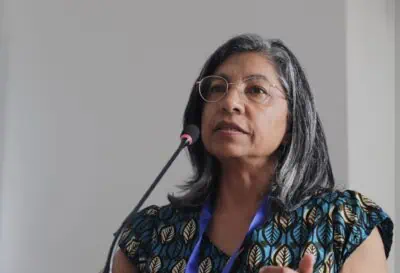
On May 28, 2022, the quiet of Luz Marina Arias’s home in Táchira, Venezuela, was shattered when five armed, masked men stormed into her house. They came looking for her 29-year-old son, Daniel. Terrified, Arias tried to shield him, clutching him tightly as the men, with their weapons pointing at her, said: “Either you come with us, or we kill your mother.”
Within seconds, Daniel was led away. The last words Arias heard from her son were meant to reassure her, but they did little to calm her fears: “Don’t worry, Mom, I’ll be back soon.” This was the second time in weeks that Arias’s family was torn apart. Just 20 days earlier, her youngest son, Juan Nair, 24, who has autism spectrum disorder, had also been abducted.
It wasn’t until the next month that Arias discovered her sons were being held in a prison in Caracas, over 500 miles away, accused of conspiring against President Nicolás Maduro’s regime. Both had been tortured — subjected to electric shocks and burned with a hot iron. Since then, her sons have not had access to justice and remain incarcerated, with Arias fighting tirelessly for their release.
“If I stay silent, if I don’t speak, they are going to remain in prison,” she said in an interview for this story, “so I have to speak, I have to make it visible because it’s a massive injustice. Too much injustice for me to remain silent.”
Amid protests demanding an end to his authoritarian rule, Maduro was sworn in for a third term on Jan. 10. In response, the regime added 50 more political prisoners to the current total of 1,794, marking a continuation of Maduro’s legacy of widespread political persecution.
Despite the growing crackdown since Election Day on June 28, families around Venezuela’s call for justice have grown louder, giving voice to those whose loved ones have spent years incarcerated. Like Arias, many of these families have seen their loved ones imprisoned and tortured without evidence of wrongdoing.
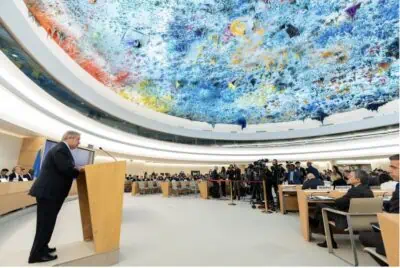
On Jan. 8, the UN spokesperson Stéphane Dujarric said that Secretary-General António Guterres was “deeply concerned about reports of further arbitrary detentions and persecution against members of the opposition,” calling for the respect of international human rights rules and standards in Venezuela.
The United States government, which refers to Maduro’s “illegitimate attempt to seize power in Venezuela,” after he “lost the 2024 presidential election,” is offering a reward of $25 million each for information leading to the arrests and/or convictions of Maduro and his Minister of Interior Diosdado Cabello.
“What is happening in Venezuela is the same to all dictatorships by definition,” said José Moya, a professor of Latin American history at Barnard College, in New York City, about arbitrary detentions. “But this happened at a time when it was very difficult to have a dictatorship that did not try to present itself as a democratic regime.”

In these oppressive regimes, mothers like Arias have become central figures in resistance movements, bearing the emotional, economic and physical toll of their loved ones’ suffering while fighting for justice. Movements like the Mothers of the Plaza de Mayo during the 1980s, who protested the forced disappearances of their children during Jorge Rafael Videla’s dictatorship in Argentina, became powerful symbols of defiance.


“Mothers have a cultural sensitivity,” Scott Mainwaring, a political science professor at the University of Notre Dame, said. “For cultural reasons, it’s a little bit harder to attack grieving mothers.”
Over the past two years, Arias has visited her sons only a few times. Each visit has brought her face to face with their deteriorating health. Daniel suffers from PTSD, while Juan Nair battles pneumonia. Arias believes the officials are trying “to kill them little by little.” She added: “They were not conspiring against any government. Everything was a montage.”
Arias and her lawyer have yet to gain access to the case files against her sons. “A military man accuses them of selling information to Colombia,” she explained. “But they don’t specify what type of information or to whom — just that they sold it to Colombia.”
Daniel’s arrest is linked to his former role in the National Guard, where he served as a secretary organizing schedules for top officials’ bodyguards. His pay was low, and he struggled to support his wife and son. To make ends meet, Daniel sold clothes and worked as a moto-taxi driver.
Eventually, he resigned from the National Guard, but his brother Juan Nair was later approached by a lieutenant colonel who invited him to join. Despite Arias’s warnings about the financial hardships Daniel faced, Juan Nair accepted and the next time Arias saw him, it was in jail.
Since 2013, families in Venezuela have fought an uphill battle against a justice system that has become a tool of political repression. Luis Armando Betancourt, a coordinator for Foro Penal, a human rights organization based in Venezuela, said what they have registered in their database “is that all the people there are innocent and were simply taken as numbers to intimidate, to repress, or to be used as bargaining chips.”
Incarcerated individuals are routinely denied basic rights — access to lawyers, phone calls and even a reading of their rights. These practices have turned the judicial system into a weapon to punish dissent.
Betancourt has witnessed firsthand the anguish of mothers whose children are imprisoned in Tocuyito, Carabobo State, some of whom are forced to sleep outside the prison, hoping that they might hear something about their loved ones.
“My mom waited two days outside, hoping they’d free my brother, but only 32 were released from that prison,” said Susej Moreno, whose brother Johan was arrested on Aug. 2 and, like many others, accused of terrorism. Moreno recalled urging her mother to leave the prison after the police repeatedly harassed and moved them.
From the US, where she now lives and works, she sends money to her mother to help cover the costs of visits and necessities for Johan. She is one of more than half a million Venezuelans who have migrated to the US, only a small amount of the 7.8 million who have left their country in the past decade.
Last November, approximately 250 prisoners were released, yet mothers continue to fight, hoping next time it will be their children who are let go. Through social media, they amplify their stories, protesting and ensuring their children’s struggles are not forgotten.
With Maduro’s grasp of power, however, Arias feels uncertain about might happen now. She hopes the government will begin to release more political prisoners, “even though what it is doing is imprisoning more innocent people,” she said. Through all the uncertainty and sadness she feels, one truth remains unshakeable: “On July 28, 2024, the people of Venezuela decided to be free.”
This story is a collaboration between PassBlue and Prof. Aida Alami at the Columbia University Graduate School of Journalism.







Sad to see this kind of article on PassBlue. The anecdotal approach is intended to invoke a host of negative emotions about Venezuela, without once addressing the fact that millions of Venezuelans support their government. A classic example is the description of the inauguration taking place ‘amid protests’, while ignoring that far more people marched that day in support of the government. Nor is their any mention of the election itself, after which a court ruled that Maduro had been elected. Instead, the assumption is that this is a hated dictator.
I would ask PassBlue to get someone from Venezuela Analysis (venezuelaanalysis.com) to write a rebuttal to this piece. The difference would be that, instead of having someone who does not live in the country write the piece, it would be written by a staff member of Venezuela Analysis who actually lives in Caracas, and who actually was in the streets on the day of the inauguration.
Excellent article! It sheds important light on the human impact of political repression in Venezuela and the bravery of those seeking justice. A crucial read for understanding the ongoing struggles under Maduro’s regime.
Congratulations to Mariana Hernández Ampudia for an outstanding article on the injustices under the Venezuelan regime. Your work sheds much-needed light on the harsh realities many face, and it’s a powerful reminder of the importance of speaking up against oppression. Thank you for using your voice to inform and inspire action—this is journalism at its best!
Thank you for sharing this powerful story of the bravery of mothers like Luz Marina Arias and the urgent need to address human rights abuses in Venezuela.