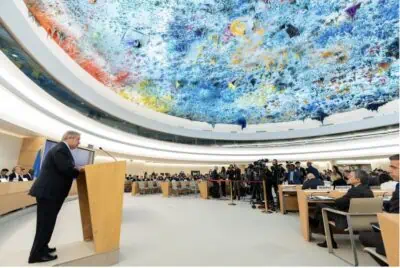





The Human Rights Council began its first session of the year on Monday amid seismic political shifts. The most noticeable change was the absence of the United States after President Donald Trump severed ties with the Geneva-based body.
While Washington ended its prior term as one of the 47 Council members in December, the move still marks a stark departure from former President Joe Biden’s efforts to re-engage the US in multilateral diplomacy. Despite its absence, the US and its foreign policy U-turn will cast a long shadow over the Council’s six-week session as countries grapple with highly divided politics.
The session’s opening on Feb. 24 coincided with the three-year anniversary of the war in Ukraine, which has displaced over 10 million people and left 40 percent of the population in need of humanitarian aid. The timing couldn’t be worse for Kyiv amid the growing rift with the US, its staunchest ally and a key player in garnering up support for its cause among other states.
Nevertheless, European diplomats appear confident they can rally sufficient support to renew the Commission of Inquiry on Ukraine by leveraging Moscow’s isolation and the US’ loss of interest in the Council. US officials have reportedly not engaged in negotiations over key proposals set to be considered at the session’s end.
However, this last month has offered a taste of the new administration’s unpredictability. The US voted against European Union-led efforts to pass a resolution condemning the Russian invasion at the UN General Assembly as Washington is pursuing a peace deal with Moscow. Should Russia object to the Human Rights Council’s scrutiny, the US might be compelled to intervene.
Conversely, Washington’s absence may offer relief to some allies, who might otherwise have clashed with its conservative stance on issues like LGBTQI rights, sexual and reproductive rights and gender equality. This session also marks the 30th anniversary of the Beijing Declaration, a landmark blueprint for advancing women’s rights. “We need to ensure this session reaffirms, rather than rolls back, the declaration,” one western diplomat said.
The US empty-chair policy has also raised concerns that other nations may exploit the opportunity to expand their influence and redefine human rights norms in their own view. Over the last three years, the US has spearheaded scrutiny of China’s abuses in Xinjiang. Uyghur and Tibetan activists fear the issue may now lose visibility. Aside from its own human rights issues, diplomats believe Beijing will not challenge the status quo and instead try to portray itself as a “stabilizing force” in the multilateral arena.
Middle East on the agenda
The Middle East, a longstanding focus of the Council, has also seen major shifts that will predictably affect discussions. The fall of the Bashar al-Assad regime in Syria has ended nearly 15 years of isolation, opening the war-torn country to UN cooperation. In recent months, UN human rights experts have visited the country for the first time since the beginning of the war in 2011 and met with the new leadership, which appears receptive to scrutiny.
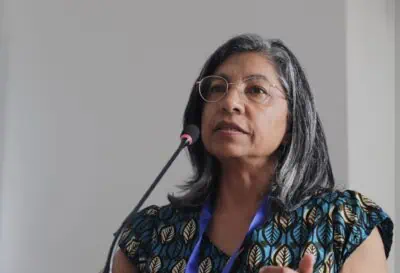
But rights organizations worry that with Assad gone, the Council and the UN more broadly might abandon accountability efforts. Jeremie Smith, director of the Cairo Institute for Human Rights Studies’ Geneva office, said this fear has already been confirmed by some states, which have indicated they no longer see the need to renew the 14-year-old Commission of Inquiry on Syria.
The Western group that has led the initiative in the past has announced it will seek to prolong it, though its future focus is still undecided. Syria faces immense challenges, ranging from justice for past abuses to the fate of tens of thousands of missing persons to emerging threats for vulnerable groups like Kurds, Alawites, Druze and women.

In Gaza, the ceasefire teeters on the brink of collapse as Israel faces internal pressure to resume hostilities, which have already claimed around 48,000 Palestinian and 1,700 Israeli lives. Trump’s controversial suggestions of turning the strip into a luxury resort have sparked concerns about the illegal displacement of over two million Palestinians.
With Israel following in US footsteps in disengaging with the Council, Palestine and its allies will have no choice but to air their grievances at an empty chair. It isn’t clear yet how they will approach the issue. Last year, they took an unusually confrontational stance by calling for an arms embargo on Israel and urging Switzerland to convene a conference on international humanitarian law in the occupied Palestinian territory, expected to take place next month.
“It is critical that states use this session and resolutions on the situation to highlight the obligations of UN member states to take steps to ensure adherence to the rulings of the International Court of Justice and the International Criminal Court,” Smith said, also calling for condemnation of recent attacks on the institutions, including the recently announced US sanctions on International Criminal Court officials.
Financial troubles
Still, efforts over the next weeks may prove futile if the Council and the human rights system lack the resources to function. On top of withdrawing from the Human Rights Council, Trump has ended financial support. The UN body relies on mandatory contributions from member states. Last year, a deepening liquidity crisis forced the UN, including its Geneva-based human rights branch, to cut back on expenses, hindering investigations and other rights monitoring activities.
The US decision to halt all foreign aid has further strained the UN’s finances. Last year, it was the UN Human Rights Office’s largest donor, accounting for 13 percent of voluntary donations. Other Western donors are under pressure to compensate for the gap, but with countries like France, Germany and Switzerland already cutting their own aid budgets, this seems unlikely.
Beyond the UN, human rights nongovernmental organizations have also suffered, with many announcing layoffs and suspending operations. An official from the International Geneva Welcome Centre, CAGI, told Geneva Solutions that while some NGOs had to reduce their delegations for the session, none had entirely canceled travel plans so far. Some groups have, however, withdrawn from next month’s Humanitarian Networks and Partnerships Weeks.
If the US freeze becomes permanent, it could severely weaken NGOs that not only denounce abuses at the Human Rights Council but also provide crucial independent reporting — a concern echoed by Western diplomats who fear the long-term consequences on the UN human rights system but appear at a loss for solutions.
This article was reposted courtesy of Geneva Solutions through Creative Commons license BY 4.0.