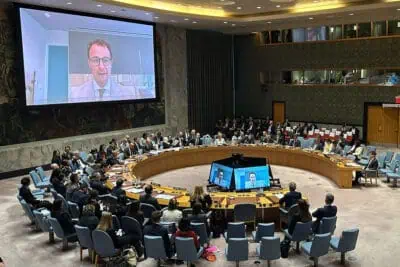





As the American nominee for United Nations envoy remains glued to her Congressional seat, United States diplomats are carrying out Trump administration agendas at the UN. These range from exonerating Russia for its war in Ukraine and cutting language on gender and diversity in UN entities — striking at a core mantra of the organization’s “we the peoples.”
Elise Stefanik, a member of the House of Representatives (R-New York), was nominated by President Donald Trump as the UN ambassador. Though her candidacy has not been voted on by the full Senate, she sailed through its committee hearing on Jan. 30, echoing Trump by saying, “America first peace through strength leadership to the UN.”
Recent reports say that she is not only needed in the House to help Republicans squeak their budget resolution through with a narrow majority but also because if she resigns and vacates her seat, a special election to fill it could be delayed, enabling Democrats to possibly win and narrow the House gap further. (Her office did not respond to requests seeking comment.)
At a recent meeting of the Conservative Political Action Conference (CPAC), referring to the UN neighborhood in Manhattan, Stefanik said, as if she were based there, “Our team is already hard at work on behalf of the President and the American people at Turtle Bay as I finish my work to enact his agenda in Congress, on behalf of my constituents and the American people.”
Yet, Stefanik is not any step closer to Turtle Bay than when she was nominated in November. The US mission to the UN is expecting her arrival, however, with staffers from her Congressional office to join her, including Anna Pusey, her press secretary.
For now, the US mission is being run by a Foreign Service officer, Dorothy Shea, an ambassador who came on board last summer, a year after President Joe Biden nominated her as deputy permanent representative (with rank of ambassador) to Ambassador Linda Thomas-Greenfield. She has returned to retirement after serving for Biden, and Shea has become interim chief of mission. Under the “U.S. Mission Leaders” tab on the website, it lists only Shea.
As the US delegation strives to keep up with the demands of a mercurial, norm-breaking president in the White House and with DOGE, or the Department of Government Efficiency, some people in Stefanik’s 51st district wonder where she is, too.
Protests in a small city near Albany, chanting “Where’s Elise?” was reported by media on Feb. 23. Members of Indivisible ADK Saratoga, a group opposing conservative policies, according to WRGB in Albany, gathered in Glens Falls “to urge Stefanik to engage with her constituents and fulfill her duties as their representative.”
“Where is Elise when we need her?” a resident is quoted. “She’s supposed to be representing us. She’s supposed to be working for democracy, not a dictatorship, so I don’t know where she is.”
On Feb. 26, Stefanik was sitting with other Cabinet members in a White House meeting with Trump and Elon Musk, who runs DOGE.
Some Foreign Service officers who worked at the US mission under the Biden administration left at the end of the year, but a crew is still holding the fort. Numerous civil service staffers have stayed on as well, but their jobs are being scrutinized by DOGE through emails sent to all federal employees.
On Feb. 26, Trump told media at the White House that the “do people exist?” email recently sent to federal employees implied that “if you don’t answer, I guess you get fired.”
Musk said at the same meeting that although the email, which asked federal employees “what did you do last week?” was a “pulse check,” people could now respond by saying they were working on classified matters.

Foreign service officers are apparently exempt from the federal employee missives from DOGE, but they face warnings about “performance,” “retention” and other job-related measures in the MAGA sphere.
[Update, Feb. 28: The US State Department said in reply to PassBlue’s request for a comment: “As a general matter, the State Department does not comment on internal communications.” It also said the State Department would respond to Office of Personnel Management questions “on behalf of the Department employees”]
Shea’s team has been carrying out Trump’s agenda. John Kelley is No. 2, acting US alternate representative, filling in the shoes of Robert Wood, who retired in January.
This week, the US delegation failed to get its General Assembly draft resolution on the three-year anniversary of the war in Ukraine adopted, but it succeeded later in the day in the Security Council, with Russia and China voting yes and the other veto powers, Britain and France, abstaining.
Brief but profound in its message for what it didn’t acknowledge, the document came straight from the White House and did not refer to Russia’s illegal invasion of Ukraine or demand that Russia withdraw its troops. The US delegation called the text a “path to peace,” but it offers no security guarantees to Ukraine or even its participation in potential peace talks.
Although Shea’s remarks to the Council before the vote also ignored Russia’s incitement of war in Ukraine in 2022, she said just days earlier, on Feb. 18 in a Council session on multilateralism, “Russia’s war on Ukraine is the bloodiest in Europe since the founding of the United Nations after World War II. This war needs to end.”
On the same day, Trump called President Volodymyr Zelensky a “dictator.”
A day before, on Feb. 17, Kelley of the US mission said to the Council: “Russia must immediately end its war against Ukraine, which not only violates international law but was also a strategic error for Russia.”
Meanwhile, the US delegation has been telling some UN entities that they must excise language on diversity, equality and inclusion, or DEI, from their work. The US remarks have been repeated in one form or another to the boards of UN Women, Unicef and World Food Program. (The latter two are run by Americans.)
“The United States cannot agree to country program documents that contain terms and concepts that conflict with U.S. policies as set out in President Trump’s recent Executive Orders, especially when those concepts endanger the very mission of the organization. Diversity, Equity, Inclusion and Accessibility (DEIA) programs violate the text and sprit of our laws by replacing hard work, merit, and equality with a divisive and dangerous preferential hierarchy,” Jonathan Shrier, acting representative to the UN Economic and Social Council, said on Feb. 10 to UN Women executives.
“We urge UN Women to focus on efforts to ensure the equality of women and girls, and insist upon avoiding a focus on radical causes such as DEI and gender ideology, neither of which will improve the functioning of UN Women and both of which are demeaning, unfair, and dangerous to women and girls,” he continued.
In a report from Devex, a US representative proposed behind a closed-door meeting of the C-34 — the UN’s troop-contributing countries to peacekeeping — that efforts to increase the number of women in peace operations, a longstanding campaign to equalize missions, should be cut back.
The US also recommended that in the UN’s annual report on peacekeeping priorities that it drop gender and inclusion language (top peacekeeping troops come from Nepal, India and Bangladesh as well as Africa); and that “international law” and “international humanitarian law” should be replaced with “relevant legal obligations.”
At least one country in the meeting, Brazil, stood up for incorporating a gender lens in the UN report. Ambassador Sérgio França Danese said that as the 25th anniversary of Security Council Resolution 1325 is commemorated this year, mandating women’s roles in peacemaking, “we should . . . continue to make progress towards gender equality in all matters related to international peace and security.”