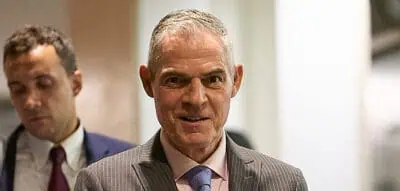
Pending a United States Senate confirmation hearing that some Democrats have promised would be brutal, Mike Waltz, the former national security adviser to President Donald Trump, is one leg toward New York City as the American ambassador to the United Nations. If confirmed, he will meet colleagues who are skeptical about his ability to deliver the vital work of diplomacy that is required at the international body.
The mishandling of sensitive national security information during Waltz’s short stint as the national security adviser does not inspire a lot of confidence in his ability to deal with delicate UN matters as intense global attention focuses on the US over its radically shifting foreign policy. That includes cold-shouldering European allies as well as warming relations with Vladimir Putin of Russia.
Indeed, UN insiders are also unsure what to expect if Waltz becomes ambassador largely because of the intense media coverage of his performance in the White House. His serious blunder in the Signalgate scandal has dampened enthusiasm for his ability to do the job well at the UN even before he assumes office. (So far, a Senate Foreign Relations Committee hearing is not scheduled.)
Most important, there’s also an undercurrent of apprehension about whether Waltz will hold real influence with Trump. “In the Council, only power matters at the end of the day,” said Richard Gowan, UN director at the International Crisis Group think tank, in New York City.
Waltz, 51, barely crossed the first 100 days in office before he was suddenly tapped for the UN envoy position after being ousted from Washington. Reports suggested he was sacked from the West Wing because of mounting problems in his security policy approach with the president. But the most obvious crisis of confidence was his inadvertent leak of US military actions in Yemen to The Atlantic journalist Jeffrey Goldberg when Waltz added him to a Signal app group, where details of the operation were discussed.
Trump has tried to defend the former US congressman from Florida and ex-Green Beret amid questions as to whether his exit from the White House is a demotion. “I actually think it’s a high position. It’s an upgrade,” the president told journalists on Air Force One on May 4. “I did not lose confidence in him. He is going to the United Nations. I think, personally, I’d rather have that job than the other.”
However, Trump has not said whether the UN ambassadorial role will be designated as a high-ranking post. The US president reserves the right to make the position cabinet-level, which gives the person direct access to the president. While the envoy role is highly coveted and has been designated cabinet-level by several past presidents, including, most recently, Ambassador Linda Thomas-Greenfield under President Biden, there have also been instances when the US ambassador to the UN was not part of the inner circle.
Kelly Craft, who served as the US ambassador to the UN during the second half of Trump’s first presidential term, did not have that status. John Negroponte, the US envoy under President George W. Bush, was ranked as a regular ambassador. Nevertheless, the envoy post has been a launching pad for some people who have gone on to be national security advisers, secretaries of state and even make a shot for the highest job in Washington.
“It’s hard to see that going from national security adviser to just being a normal ambassador,” Robert Wood, a former US alternate ambassador to the UN under Biden, said in a phone interview. “The position would be just like any other ambassadorship in terms of hierarchy if it’s not a cabinet-level rank. So some might perceive that as a demotion.”
Waltz’s experience in national security, given his military background, provides obvious gravitas, but the complexities of the UN system itself — its byzantine rules and procedures and opaque geopolitical dynamics — are likely to pose a steep learning curve for him. Much will depend on his ability to lean on experienced colleagues like Dorothy Shea, the current interim chief of the US mission to the UN and a career diplomat. She was appointed to the post by Biden in 2024. The broader US mission team is also crucial to Waltz’s success, Wood said.


Nonetheless, there is a sigh of relief among UN diplomats, who were disappointed that Elise Stefanik’s candidacy was pulled as US envoy, that US business at the UN would be handled by a top government official. Particularly, countries like Israel and Ukraine, who rely on the US for extensive military and diplomatic support, have high expectations for Waltz. (PassBlue was unable to contact him.)
For them, Waltz’s stance at the UN has far-reaching international implications. One of Waltz’s several serious missteps at the White House was his alleged discussions with Israeli Prime Minister Benjamin Netanyahu regarding a potential large-scale military operation in Iran, which was regarded as off-tangent with Trump’s policy. Netanyahu confirmed he had conversations with Waltz but dismissed that they were “extensive.”
“Ukraine is looking forward to working collaboratively and constructively with any US Permanent Representative to the UN,” Sergiy Kyslytsya, Ukraine’s first deputy foreign minister and former UN ambassador, wrote to PassBlue. “The upcoming confirmation hearings of the new US candidate to the position will certainly generate lots of attention, and are important to have an informed opinion of how the future ambassador intends to implement President Trump’s foreign policy in the UN.”
Despite the uncertainty surrounding Waltz’s nomination and potential complications that the UN Security Council expects with any Trump appointee on issues in the Mideast, some observers expressed optimism that he might beam light on other neglected crises.
“I think other Council members will hope that Waltz will get the Council to focus more effectively on problems like Haiti, which the Biden team prioritized but the U.S. has let drift since January,” Gowan said in an email to PassBlue.