







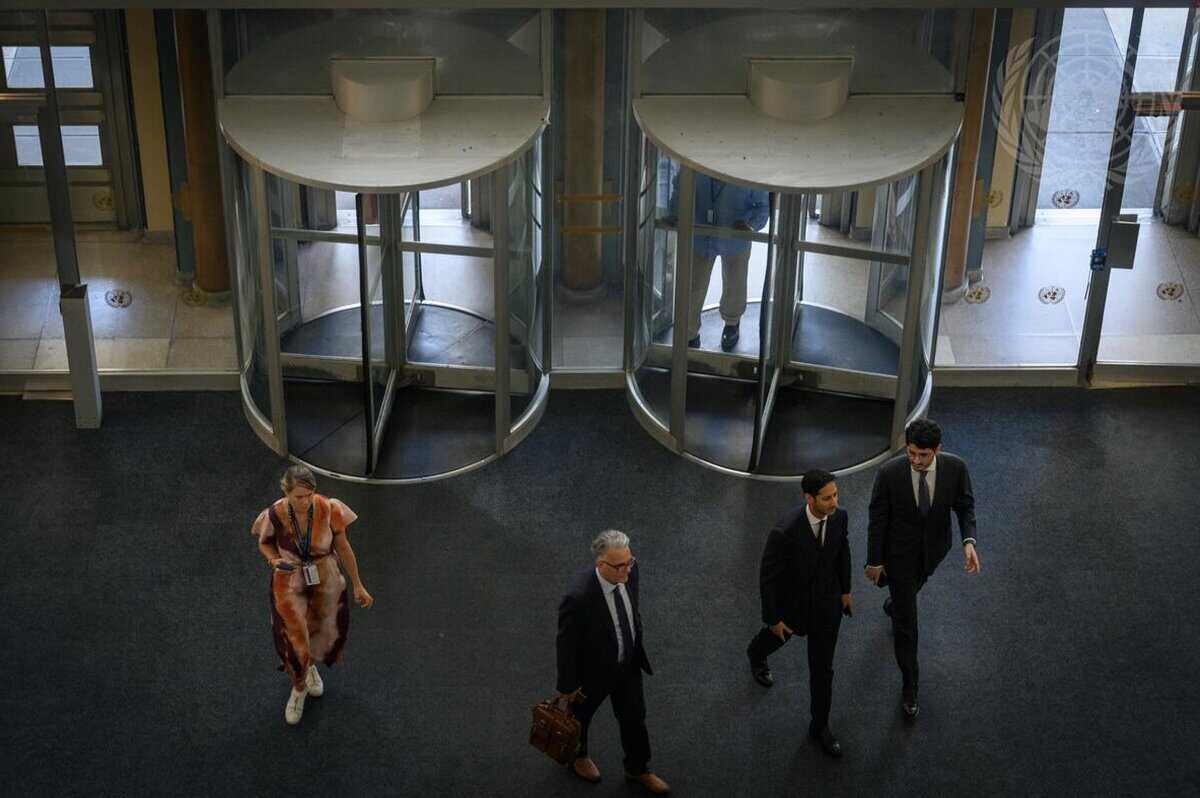
The mood during the United Nations General Assembly high-level week in late September was more somber than celebratory. French President Emmanuel Macron captured it succinctly, saying: “This 80th anniversary isn’t a party.”
There are plenty of reasons that few people are in a festive spirit. The world faces multiple crises, from environmental catastrophe to the unfettered growth of artificial intelligence, and the UN itself is under intense pressure, struggling to remain relevant while its funding and future remain uncertain.
UN Charter review
Article 109 of the UN Charter provides a path out of this malaise. The provision allows for a general conference to be held to review the Charter if it is supported by two-thirds of the General Assembly and nine members of the Security Council.
This was part of the original plan. When the Charter was adopted, United States President Harry S. Truman was clear, saying: “This Charter . . . will be expanded and improved as time goes on. . . . Changing world conditions will require readjustments.” Eighty years later, that promise remains unfulfilled. Article 109 has never been invoked.
Some world leaders argue that the time has come to do so.
At the recent annual opening session of the General Assembly, Barbadian Prime Minister Mia Mottley declared that “the world needs a reset” while Kenyan President William Ruto stated that “institutions must be re-imagined, reformed, renewed and aligned with emerging realities.”
“Young generations have the right to a renewed Charter,” North Macedonian President Gordana Siljanovska-Davkov noted. Kazakhstan President Kassym-Jomart Tokayev said that now is the time to have a “serious conversation” about Charter review. In a joint statement, Brazil, India and South Africa also made the case for an Article 109 conference.
These countries join Cameroon and the many former heads of state, Nobel laureates and civil society organizations that support a review gathering. On the sidelines of the General Assembly, the Article 109 Coalition was launched to mobilize more countries to back a Charter review.
Why invoke Article 109?
The UN was designed to prevent another great-power war. While that remains a vital goal in an age of resurgent hard power, its Charter is silent on modern existential threats: climate change, pandemics, cyberwarfare and disruptive technologies. In her address, President Siljanovska-Davkov of North Macedonia laid out that the Charter needs to be updated to confront these challenges.
In addition, the Security Council’s veto-holding members — Britain, China, France, Russia and the US — reflect the geopolitics of 1945, not 2025. Only 50 countries of the current 193 member states were present at the San Francisco conference when the Charter was signed, as much of the world was still colonized. The world has changed. The Council has not.
This imbalance of power has led to the fragmentation of the global system of collective action. Minilateral and regional groupings (from the G20 and BRICS+ to other ad hoc coalitions) have proliferated as faith in multilateralism has waned. These smaller groupings are less representative, accountable and transparent than the UN. A Charter review meeting could reinvigorate the multilateral system before it splinters further.
Ultimately, incremental UN reform has failed. Decades of negotiations on Security Council reform have not produced real outcomes, other than frustration and cynicism. The UN Summit of the Future in 2024 generated global dialogue but not transformation. UN80, Secretary-General António Guterres’s reform initiative, has been criticized for focusing on cost-cutting rather than on fundamental changes. Cosmetic surgery, or even amputating some limbs, is insufficient to make the UN the body the world needs.



Valid risks
Could a review conference expose divisions in the UN and weaken the Charter?
While the current geopolitical climate may not seem conducive to reform, postponing Charter review until “auspicious” circumstances has been an excuse since 1955. The risks of review must be balanced against the risks of not doing so: the current trajectory of the UN and the rest of the world is untenable.
As the former Belgian Prime Minister Alexander De Croo has argued, certain principles, such as human rights and sovereignity, could be ring-fenced, meaning the review conference would focus on other aspects of the Charter. This could center on restructuring the Security Council, strengthening democratic participation through a Parliamentary assembly or establishing a new environmental council.
But any amendment would require ratification by two-thirds of member states, including all five permanent members of the Security Council, to take effect. This high threshold offers a backstop against regression.
A path to a revitalized future
The Article 109 Coalition proposes that the vote to invoke Article 109 takes place in 2027, with the conference itself being part of the post-Sustainable Development Goals agenda.
This would signal that the UN is not “trapped in amber” as some analysts have called the UN’s stasis, with the review being a normative opportunity to show that the organization is responsive to emerging challenges.
Importantly, an Article 109 conference does not predetermine results; it creates a forum. And while it carries risk, the process could restore confidence and credibility to the world.
As the former Irish President Mary Robinson noted at the Article 109 Coalition’s launching in September in New York City: “The moment has come, and we need to be brave . . . we need a UN that is fit for purpose, that is at the center of tackling peace and security, that is at the center of health issues, that is at the center of the climate crisis.”








Great diagnosis. No proposals. Is there political will to change. Who gains with a weak UN? The UN Charter begins with “We the People”. Thus, the big reform is to bring the people to the UN. And, there is a formula. Also we need a different type of UNSG. The true power of the UN is moralsuation. Thus, a profoundly conscious and spiritual leader. Alfredo
National sovereignty over national issues should be ringfenced. Resolving global issues requires global cooperation which requires enforcement of agreed global rules. National sovereignty is the wrong tool for global governance and for the resolution of global tragedies of the commons, such as climate change. This is exactly why global challenges are proving so intractable. To resolve shared global challenges humanity needs to create shared global sovereignty, strictly bounded by strong subsidiarity. Hence the proposal for a United Nations Parliamentary Assembly (representing the people) to sit alongside the General Assembly (representing the states). And note that a well-governed planet is will cost humanity far less than a poorly governed planet.
Many useful ideas and proposals can be found in the reports of the Special Committee on the Charter of the United Nations and on the Strengthening of the Role of the Organization which marked this year its 50th anniversary.
An article 109 Conference will be useful, but will probably not abolish the veto’s in the UN Security Council. One possible way to achieve this might be for France and the UK, who have not used their veto since 1989, to submit a resolution to the UNGA that they are willing to forego their veto if the other three – China, Russia and the US – do likewise.
The abolishing of the veto is the central, the most important part of the review. Otherwise Art. 109 Conference would not change much. By the way, Art. 109 was drafted and added EXACTLY as to remove the veto in the first place, nothing less. We need to respect the will of all those back in 1945 who regarded the veto as a temporary gift to the P-5 and demanded Art. 109 exactly to remove the veto.