






This Week @UN: SecGen’s lukewarm US condemnation; Israel complicates Somalia’s Security Council presidency; US ditches UN entities.
Plus: Come to Venezuela; hands off Greenland; Syrian strife; Minnesota killing; Ukraine burns.
Follow us on Blue Sky, Twitter (X), Facebook, Instagram and LinkedIn
Our #1 story: UN Persons of the Year for 2025: Readers’ Survey
• We thank everyone for their generosity to our annual fund-raising campaign, which by our latest accounting reaped close to $50,000, which is a handsome sum for a small newsroom like ours and as money is scarce across the world, as an African development expert told us last summer. The donations boost our spirits as we dive into the new year, covering an emergency session on Venezuela, Somalia’s Security Council presidency and the United States withdrawing from 31 UN entities, all in one week. (Our dynamo Damilola Banjo reported on all three stories; see below.) — PASSBLUE TEAM
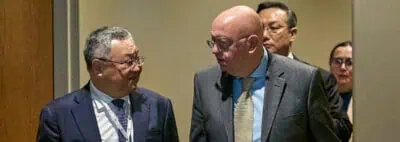
• Venezuela’s UN envoy Samuel Moncada “expressed regret” to UN Secretary-General António Guterres in a meeting with him on Jan. 7, saying the UN had not condemned the threat and use of force by the United States against Venezuelan territorial integrity and political independence, according to a statement in Spanish published by Venezuela’s Foreign Minister Yvan Gil that morning. Translated into English, Moncada apparently added that the UN can still play an important role to preserve “diplomacy as a means to guarantee world peace.” In that vein, he invited Guterres to visit Venezuela or appoint a personal envoy “so that they may witness firsthand the consequences of the military attacks” of the US on Jan. 3. The statement says Guterres “indicated that the recent U.S. military incursion into Venezuelan territory represented a flagrant violation of the UN Charter and the norms of international law” and “set a dangerous precedent for international relations and expressed concerns regarding its repercussions for the Latin American and Caribbean region, including its proclamation as a Zone of Peace.” Guterres also “expressed gratitude for the offer” to visit “and committed to considering it, while offering his good offices to promote a national dialogue.”
In a brief readout of the meeting, however, the UN spokesperson, Stéphane Dujarric, said that Guterres had reiterated to Moncada “his publicly-stated position on the US military action in Venezuela” but no mention of a visit. (His remarks, in part: “I am deeply concerned about the possible intensification of instability in the country, the potential impact on the region, and the precedent it may set for how relations between and among states are conducted.”)
After the 45-minute meeting between Moncada and Guterres, PassBlue asked the Venezuelan whether he had discussed his request in the Jan. 5 Security Council meeting that Nicolás Maduro, now in custody in New York City on federal charges, be granted full diplomatic immunity as a sitting head of state under international law and demanded his immediate release from US custody. (The US says Maduro is not entitled to such immunity because the US does not recognize him as Venezuela’s legitimate leader.) But Moncada declined to say whether that matter was raised with Guterres.
Relatedly, as of the end of 2025, Venezuela had lost its right to vote in the General Assembly under Article 19 of the UN Charter because it is in arrears in paying its dues. (Countries in Arrears in the Payment of Their Financial Contributions Under the Terms of Article 19 of the UN Charter.) — DULCIE LEIMBACH
• Our #1 story: UN Persons of the Year for 2025: Readers’ Survey

PassBlue this week:
• UN Condemnation of US’ Invasion of Panama Decades Ago Did Nothing. Little Has Changed Since., by Damilola Banjo
• Israeli Actions in Africa Complicate Somalia’s Presidency of the UN Security Council, by Damilola Banjo
• The US Has Yet to Notify the UN About Washington’s Withdrawal From Entities, by Damilola Banjo
PassBlue’s top stories over the holidays:
• The US Wants to Reshape the UN’s Gender Equality Agenda. It’s Doing So Alone, by Damilola Banjo
• UN Hosts Country Heads in New York City at a Big Cost, UN Insiders Say, by Damilola Banjo
• The Buddhist UN Boss Who Excelled at Mediation, by Mita Hosali
• PassBlue’s Latest Quiz: UN Security Council Rules of Procedure
Monday, Jan. 5
• Spokesperson’s briefing: The Office for the Coordination of Humanitarian Affairs (OCHA) reported that around 7.9 million people in Venezuela, about a quarter of the population, need “urgent support,” and that although the humanitarian response plan for the country has only received 17 percent of its required funding — ”one of the least funded country appeals in the world”– the UN continues to provide food and health care services to the most vulnerable. After the US attacked the capital of Caracas on Jan. 3, forcibly removing President Nicolás Maduro from office, Dujarric emphasized the “need to protect civilians and of preserving humanitarian operational continuity, so that assistance can be delivered in line with humanitarian principles.”
[Update: As to US plans to seize Venezuelan oil, Dujarric said: “The oil in Venezuela belongs to the Venezuelan people, just as the oil in Syria belongs to the Syrian people, and the natural resources of any country belong to the people of that country”]
Tuesday, Jan. 6
• Spokesperson’s briefing: Asked what the Security Council can do about US President Trump and his national security adviser Stephen Miller’s repeated claims that the US “obviously” needs to seize control of Greenland, which led several European countries to release a joint statement backing Denmark (a current member of the Council) and Greenland’s claim over the island, Dujarric said that Guterres will “continue to push both publicly and privately […] the sanctity of the territorial integrity of Member States, whether it is Somalia, […] Denmark, including the province of Greenland, […] or any other country.”
Wednesday, Jan. 7
• Spokesperson’s briefing: Guterres is “alarmed” by reports of civilian deaths and injuries during “hostilities” in the northern Syrian city of Aleppo, with the UN reiterating the “clear obligation, under international humanitarian law” of all parties to “protect civilians and civilian infrastructure.” Dujarric said the UN encourages the prompt resumption of negotiations to carry out the March 10 agreements, adding that reaching a consensus between the government and the Syrian Democratic Forces (SDF) to establish a unified, state-run security force for “all Syrians” would be an important step toward that goal.
Thursday, Jan. 8
• Spokesperson’s briefing: Guterres “regrets” the White House’s announcement that the US will withdraw from dozens of UN entities, adding that the assessed contributions to the UN’s regular and peacekeeping budgets, as approved by the General Assembly, are a “legal obligation under the UN Charter for all Member States, including the United States.” Dujarric said the UN “will continue to carry out our mandates with determination.” (Our story: The US Has Yet to Notify the UN About Washington’s Withdrawal From Entities, by Damilola Banjo)
• Asked about the UN’s reaction to the deadly shooting of Renée Good by an Immigration and Customs Enforcement officer in Minneapolis on Wednesday, Dujarric said that “anyone who’s seen the video has to be troubled, to say the least” and hopes that “people will be held to account,” but the UN will wait for a federal investigation of the event to “play out.”
Friday, Jan. 9
• Spokesperson’s briefing: Guterres “strongly condemns” a large-scale overnight Russian attack across Ukraine, disrupting electricity, heating and water supplies amid 14 degree-temperatures and killing civilians in Kyiv, including a medic, marking the ninth attack on health care in the country in 2026 alone, according to the World Health Organization (WHO). Humanitarian groups nonetheless continue to “support people in Kyiv and other impacted cities and towns,” Dujarric said, providing emergency aid despite the bitter cold.