







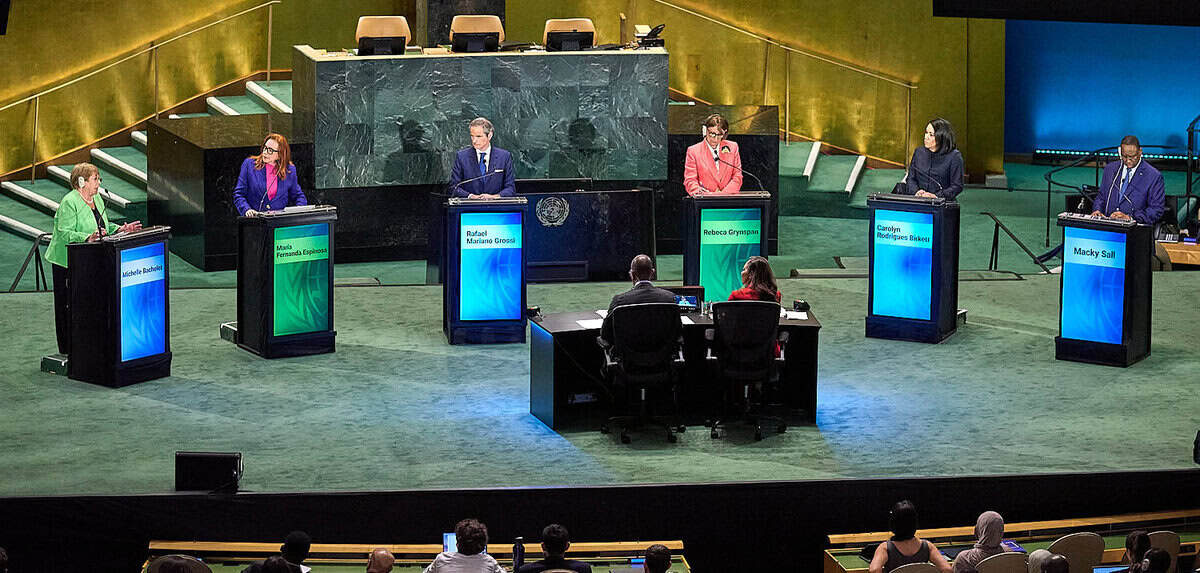
Six candidates vying to become the United Nations’ next secretary-general faced pointed questions Thursday night on whether the 80-year-old world body can still function when its Security Council is deadlocked, how they would fix an organization that nearly ran out of cash this year and what they would do about long-running complaints of nepotism inside the UN’s own ranks.
The public dialogue, held on July 23 in the UN General Assembly Hall, occurred days after PassBlue asked its own readers in an informal survey to consider, if they could, What would they most want to ask the candidates competing to become the world body’s 10th secretary-general?
Our readers sent a range of questions, topped off with how candidates would stand up to the most powerful countries in the UN, followed by the topics of Security Council reform, peacemaking, financing of the organization, UN relevance, gender equality, leadership style, restoring public trust, nepotism in the Secretariat and the independence of the UN boss.
The survey responses provided insights into public expectations of the next secretary-general to succeed António Guterres, a former Portuguese prime minister who has led the UN for nearly 10 years. Readers wanted to know, for example, if the next leader would stand up to member states when they fail their responsibilities to the UN Charter, the guiding document of the institution.
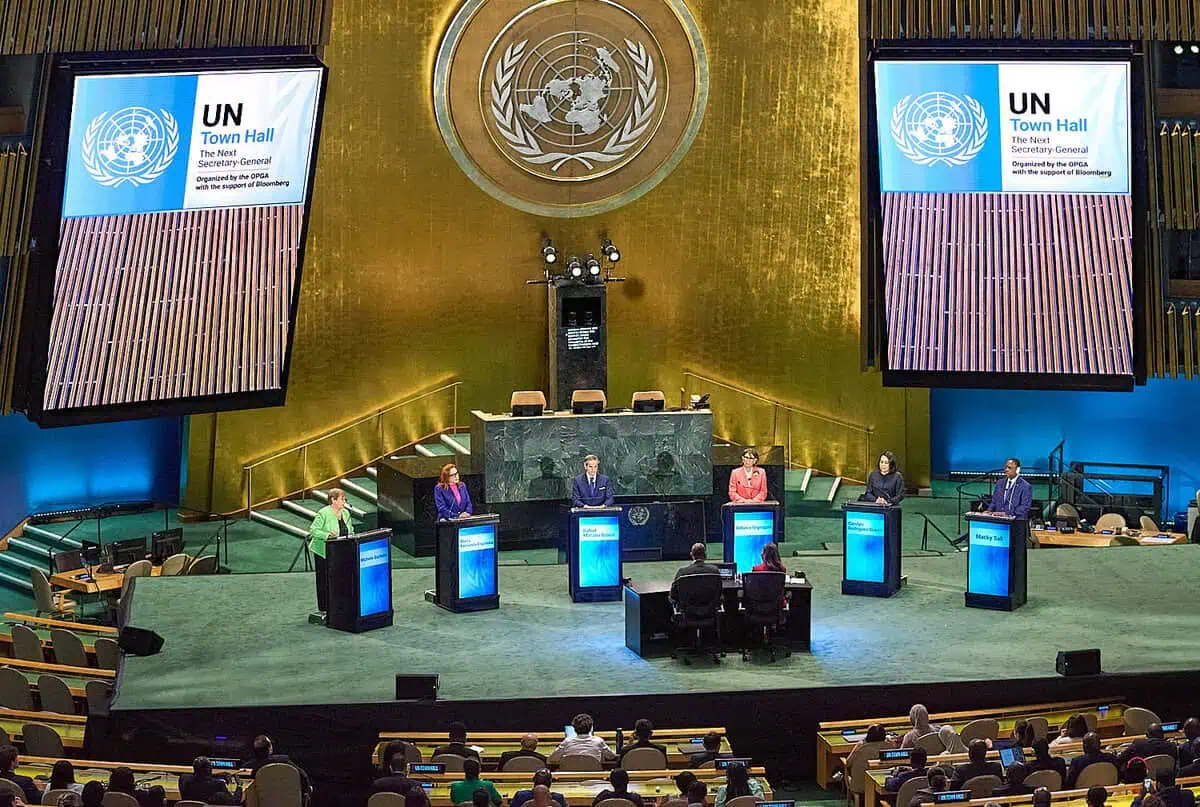
Many questions on the minds of PassBlue readers were similar to those asked of the candidates during the town hall, hosted by the president of the General Assembly, Annalena Baerbock, on Thursday night and moderated and produced by Bloomberg News.
The town hall precedes a secret straw poll to be conducted on July 30 by the Security Council, which could trigger more formal deliberations on the selection process, which is expected to be done by the end of the year.
The six candidates — Michelle Bachelet, María Fernanda Espinosa, Rafael Grossi, Rebeca Grynspan, Carolyn Rodrigues Birkett and Macky Sall — explained in timed responses before a live audience of diplomats, civil society members, UN staffers and journalists how they would tackle some of the major challenges facing the UN.
The 90-minute broadcast offered more insights, after previous public debates in the UN and elsewhere, from the candidates. Some questions were put to the nominees by the Bloomberg moderators; others were asked by diplomats, civil society representatives and UN staff. Some questions were also asked of specific nominees. Highlights:
Security Council deadlock
Top on the list of questions sent in by readers to PassBlue’s survey were those centered on the UN Security Council, which has become ineffective because of geopolitical tensions as well as disregard for international law and the UN Charter by certain countries. Complicating matters is the veto power of the permanent members: Britain, China, France, Russia and the US.
Bloomberg’s moderators opened the town hall with a theoretical question asking what the candidates would do, if they were UN secretary-general, about the hobbled Security Council and its inability to end the blockade of the Strait of Hormuz in the US-Iran war, which has disrupted global energy markets and shipping.
Espinosa, a former president of the General Assembly and defense and foreign minister of Ecuador, said that when faced with a regional war started or backed by a powerful state, she would “mobilize the muscle of the UN” to address spillover effects on countries that are not parties to the conflict but are hurt by energy prices, food prices and supply disruptions, thereby keeping the UN relevant to a wider set of states.
She also said that the secretary‑general’s comparative advantage is to be seen as an “impartial honest broker” who is physically present, persistent and trusted enough by all sides to operate diplomatically even when formal Council action is impossible.
Bachelet, a former two-time president of Chile, said that “the most important thing is that the secretary-general cannot give up,” citing its “good offices,” mediation and special envoys as tools that are available even when the Council cannot act. She said she would build a UN that is “leaner but not weak” and represented all 193 states equally. She cited the time when she was the head of UN Women, she refused to back down on a decision despite an unnamed country pressuring to pull funding from the agency. She also cited her publishing contested rights reports when she was the UN high commissioner for human rights as a testament to her moral standing.
“I will speak out loud what I think is my moral authority and my duty,” Bachelet said.
Grossi cautioned against measuring success by resolutions passed, noting that impartiality “is not indifference; it is having the ability to put forward concrete solutions.” He cited his current work as head of the International Atomic Energy Agency regarding its response to Russia’s siege of Ukraine’s Zaporizhzhia nuclear power plant, saying credibility and impartiality are UN’s real currency. He added that he would lead the organization with “brutal honesty” and with a “new deal” among the secretary-general, member states and staff.
Sall, speaking in French with English translation, said his “independence” would rest on a diplomacy that excludes no one, and that transparency is what allows member states to trust a secretary-general who is not simply following the most powerful capitals. Drawing on his own experience as a former president of Senegal and building “corridors of dialogue” regionally in West Africa, he likened the UN to an orchestra needing a skilled conductor.
Rodrigues Birkett, the ambassador of Guyana to the UN, said: “One thing the secretary-general does not have [is] the luxury of doing, and that is not trying. The secretary-general must try.”
Grynspan, a former vice president of Costa Rica and head of the UN Conference on Trade and Development (on leave), said that when the Council is in “blockade,” that is when the secretary‑general’s job really begins, to “open the possibilities for agreement.” She drew a parallel with her experience brokering the Black Sea Grain Initiative, arguing that the UN can still craft practical arrangements to protect global food and energy markets even when there is no Council consensus. Applied to the Strait of Hormuz, she said the UN should have engaged very early with all relevant actors to reopen shipping “at least for the benefit of the people that are suffering far away” from the conflict but whose lives are affected by higher prices and disrupted trade.
In another round of questions, Estonia asked Grossi what concrete steps he would take when a permanent member of the Security Council wages a war of aggression against another member state.
Grossi, the boss of the UN nuclear agency, said the secretary‑general must step in regardless of whether the aggressor is a veto-wielding state or not. He said his first steps would be to restore the UN’s credibility as a valid interlocutor and to use all the tools available in the Charter, starting with talking and listening to both sides. He added that the job requires tackling a conflict from a “realist” perspective.
Rodrigues Birkett said she had seen from her time as Guyana’s envoy in the Security Council (2024-2025), that “there is always space for the secretary‑general” when the body cannot act. In her view, the UN boss can still use mediation, good offices and special representatives without Council authorization, drawing on the UN’s field presence to gather information and put specific proposals to the Council.
If a possible veto could cause immense human suffering, she said she would go directly to the permanent member to spell out the potential consequences and try to change the country’s position, while recognizing that some actions will still require Council backing.
Grynspan said that Council gridlock is precisely the moment when the secretary‑general’s role begins. For her, the UN leader should engage very early with all actors, aim to protect people far from the battlefield (for instance, by stabilizing food and energy markets), and use such specific problem‑solving to keep the UN relevant despite great‑power deadlock.
Sall said that when the Council is blocked in a crisis — including by a P5 aggressor — the “added value” of the secretary‑general is the ability to speak with all sides, even in moments of high tension, and to maintain “corridors of dialogue” with the main belligerents and especially the permanent members. His answer was less about legal workarounds and more about persistent high‑level diplomacy to reopen channels that could eventually unblock Council action.
UN’s liquidity crisis
Ten percent of questions sent by readers to PassBlue’s survey asked how the new UN boss would address the organization’s extensive money problems. Guterres’s revised 2026 budget reduced staffing to 11,594 posts, an 18.8 percent cut from 2025, and by last summer the UN had eliminated more than 3,000 posts overall, about 21 percent of its workforce.
Earlier this month, the General Assembly overhauled a decades-old rule that had forced the UN to return cash it never actually collected to all member states in a practice that worsened the current financial crisis.
But Guterres has conceded that the change in the rule, albeit temporarily, will not entirely solve the liquidity catastrophe if member states still withhold their mandatory UN dues or pay late.
In addressing the UN’s liquidity, Grynspan, an economist, linked it to a broader political crisis, saying the solution is to build on the newly adopted General Assembly resolution to secure a stable, multiyear financial path. This means proving to member states — and their taxpayers — that the UN uses resources wisely; reforming incentives that encourage duplication and waste; and putting the organization’s finances “back on solid footing” as part of a wider reform package.
Sall said he would push for reform of the international financial institutions system so developing countries could have fairer access to capital and could attract more private investment and partnerships. This, he added, would ease pressure on the UN and make its development role more sustainable. He also stressed opening the accounting books of the UN to rebuild member‑state trust in how money is managed.
Bachelet said tackling the UN’s liquidity problems would be a top, early priority, adding that it was essential to everything else the organization does. In her closing statement, she said that in her first 100 days she would “try at least to secure the financial stability of the organization through payment of assessed and voluntary contributions, which is indispensable for all else.”
Rodrigues Birkett said she would advocate for “partnership‑based” engagement with international financial institutions and incremental, systemic changes in concessional financing terms for vulnerable countries. While UN regular budgets come from assessed contributions, she said broader global financial reforms (like better access to affordable finance and using vulnerability indices) are essential to sustaining the UN’s development and humanitarian mandates without constantly operating in emergency mode.
Leadership in the Secretariat
What qualities must the next secretary-general possess and how would she/he deal with ongoing criticisms of nepotism in the organization, lack of accountability among senior officers and gender equality both within the Secretariat and in the field, addressing frustrations among junior and midlevel UN staff.
Fengqi Zhang, a UN staff member, asked Rodrigues Birkett specifically how she would approach reform to strengthen staff morale, improve managerial efficiency and ensure accountability across the organization. In response, Rodrigues Birkett said that a secretary-general is as strong as the team around her, adding that she would have a workforce that “looks like the world it represents,” making underrepresented countries a hiring priority. On accountability, she spoke of strengthening managerial efficiency and ensuring accountability at all levels, though she did not spell out specific disciplinary or oversight mechanisms.
Espinosa and Bachelet both said individually they would build a cabinet based on competence and integrity, appointing senior officials by considering gender and geographical balance. For Espinosa, strengthening accountability starts at the top, she said, by changing the “business model” of the UN to be driven by impact, performance and transparency, rather than by inertial structures and political deals.
Grynspan said that real reform means tackling the behaviors that drive duplication and “unhealthy competition” in the system and that reform must come “from the top” as well as from the field. She said she would change the incentive structures that reward turf‑protection and opacity, which are conditions in which favoritism and impunity can thrive.
Espinosa said she would build an organization that is agile because it has transformed itself and trusted because it has delivered for people.





Can the Next UN Chief Fix a Broken Security Council and an Empty Bank Account? Damilola thank you for this great summary and title. Reading through, I found that the questions were vague especially on the first point because recent and concret examples exist e.g. How a UN Secretary General can address the war between Russia and Ukraine? How a UNSG can bring the war US/Israel against Iran to an end? How a UNSG can bring a solution to the kidnapping of President Maduro by the US and the illegal management of the Venezuelan oil by the US? How a UNSG can bring the endless wars between Israel and Palestine-Syria-Lebanon to an end? How the UNSG can lead the world to end the war in Sudan, terrorism in the Sahel and the war in Somalia where proxies of P5 are engaged? For the Empty Bank Account, I believe one answer is to fill the account but an important point is to keep it full (sustainability) so that needs of UN/Member States are attended, so some questions around these two points could have been useful!