








Denmark will test the resolve this month on whether the United Nations Security Council can implement its own 2018 commitment to ending the use of starvation in wars, as hunger intensifies the suffering of people in conflicts and divisions persist among the Council’s 15 members.
On Aug. 25, foreign ministers and other senior government and UN officials will gather for “Food Under Fire: The Security Council’s Role in Mitigating Global and Local Food Crises,” a debate convened by the Danes, who hold the monthly rotating presidency.
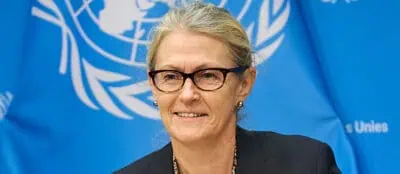
Christina Markus Lassen, Denmark’s permanent representative to the UN, told reporters that the debate would focus on how the conflicts in Ukraine, Sudan and the Palestinian territories as well as the disruptions in the Strait of Hormuz are worsening food access and availability across the world.
The debate, to be chaired by Denmark’s foreign minister, Lars Lokke Rasmussen, comes more than eight years after the Security Council unanimously adopted Resolution 2417, which under the leadership of the Netherlands at the time and the protection of civilians mandate, condemned the starvation of civilians as a tool of war and affirmed that such conduct could constitute a war crime.
Yet in the eight years since, starvation, famine, acute hunger and restrictions on humanitarian aid are now defining features of wars in many parts of the world.
“We want to see the link between conflicts and hunger, give not just Council members but the entire UN membership a chance to discuss this,” Lassen said on Aug. 3.
Additionally, the United States’ war in Iran this year is disrupting the global flow of humanitarian aid, fertilizer, gas and oil supplies and other commercial goods through the Strait of Hormuz. International shipping through the pathway has been largely blocked since Feb. 28, 2026, when the US and Israel first attacked Iran this year. The strait remains contested as the US and Iran try intermittently to broker a peace plan temporarily. The latest agreement to manage the waterway is being negotiated between Iran and Oman.
UN Secretary-General António Guterres’s latest annual report on the protection of civilians found that conflict and other violence drove acute food insecurity for 147 million people across 19 countries and territories in 2025. It also reported that for the first time in two decades, two famines were confirmed in the same year, with those conditions identified in parts of Sudan and the Gaza Strip.
More significantly, the UN’s 2026 Global Report on Food Crises says that 266 million people in 47 countries and territories experienced high levels of acute food insecurity in 2025. It also estimated that 35.5 million children aged 59 months to 6 years old were acutely malnourished in 23 countries and territories that are experiencing nutrition crises. In the report’s foreword, Guterres warned that hunger was increasingly being used as a weapon of war.
Alex de Waal, the executive director of the World Peace Foundation, a research and advocacy organization based at Tufts University, said one obstacle to carrying out Resolution 2417 — approved before the current wars in Sudan, Ukraine and Gaza – is that invoking it has generally zeroed in on specific countries, often prompting objections from certain governments on sovereignty grounds.
“What Denmark is trying to do is to get around this problem by having a more regional and thematic approach,” de Waal told PassBlue on Aug 5.
The scale of global hunger and its reliance as a weapon in conflicts make the Aug. 25 session in the Council particularly important, de Waal said. Yet the topic remains divisive among the members, where Russia has consistently questioned whether the global body is the appropriate forum for addressing hunger, arguing that food insecurity is generally a consequence of conflict rather than a cause of it. Moscow has also maintained that Western sanctions and recent reductions in humanitarian aid are worsening hunger worldwide. (Russia is not a major contributor to such aid.)
China, on its part, has resisted what it regards as the Council’s encroachment into thematic issues that should be handled by the General Assembly or specialized UN agencies. If previous debates are any indication, these differing perspectives are likely to shape the statements delivered by Russia and China on Aug. 25.


The UN’s plan
Guterres is expected to participate in the briefing as he struggles to get the buy-in of Council members regarding his proposal to let vessels carrying fertilizer to the market to move safely through the Strait of Hormuz.
Commercial traffic has fallen roughly 95 percent since the conflict began on Feb. 28. The World Food Program has estimated that up to 45 million additional people could fall into hunger if oil prices remain elevated, and it has already recorded 2.5 million more people in Somalia, 2.3 million in Afghanistan and 1.3 million in Sri Lanka pushed into acute food insecurity as a direct result.
Jorge Moreira Da Silva, a UN undersecretary-general and coordinator of the UN Strait of Hormuz Task Force, said in a statement on July 24 that the mechanism is ready, after “four months of consultations with member states.” Still, Farhan Haq, deputy spokesperson to Guterres, told PassBlue in an email on Aug. 5 that parties to the conflict have yet to approve the plan.
Denmark said in response to PassBlue’s question in its Aug. 3 media briefing about the use of Guterres’s proposal that it would depend on progress in parallel negotiations on the war in Iran and on what the parties to the conflict will accept. Iran wants to retain the authority to approve passage through the Strait of Hormuz, while Washington maintains that all commercial goods should move freely without threats or restrictions.
For the neighboring Gulf states, the UN proposal appears too narrow because it focuses primarily on fertilizer rather than the wider security of maritime traffic, and some of the countries are wary that participation could imply recognition of Iranian control over the strait. It is unclear if the latest version of Guterres’s plan addresses these issues.
Complicating matters, the disruption in the Strait of Hormuz is worsened by the emergence of a “super El Niño,” the unusually warm phase of the natural climate cycle known as the El Niño-Southern Oscillation, or ENSO, de Waal said. The World Food Program projected that El Niño could cause major crop failures across several regions and potentially leave roughly 50 million more people into severe hunger by late next year.







Demark has to broaden the case definition and add terrorism (Boko Haram, Al Qaida and the JNIM) to the list of countries or groups using hunger, gender-based violence and displacements as weapons to terrorise millions of people around the world.