



Topics covered in this article
- Niger Stresses Its Sovereignty and Thanks Algeria
- Sweden’s Smart Alice
- China Stands Up for Gaza and Cuba
Niger Stresses Its Sovereignty and Thanks Algeria
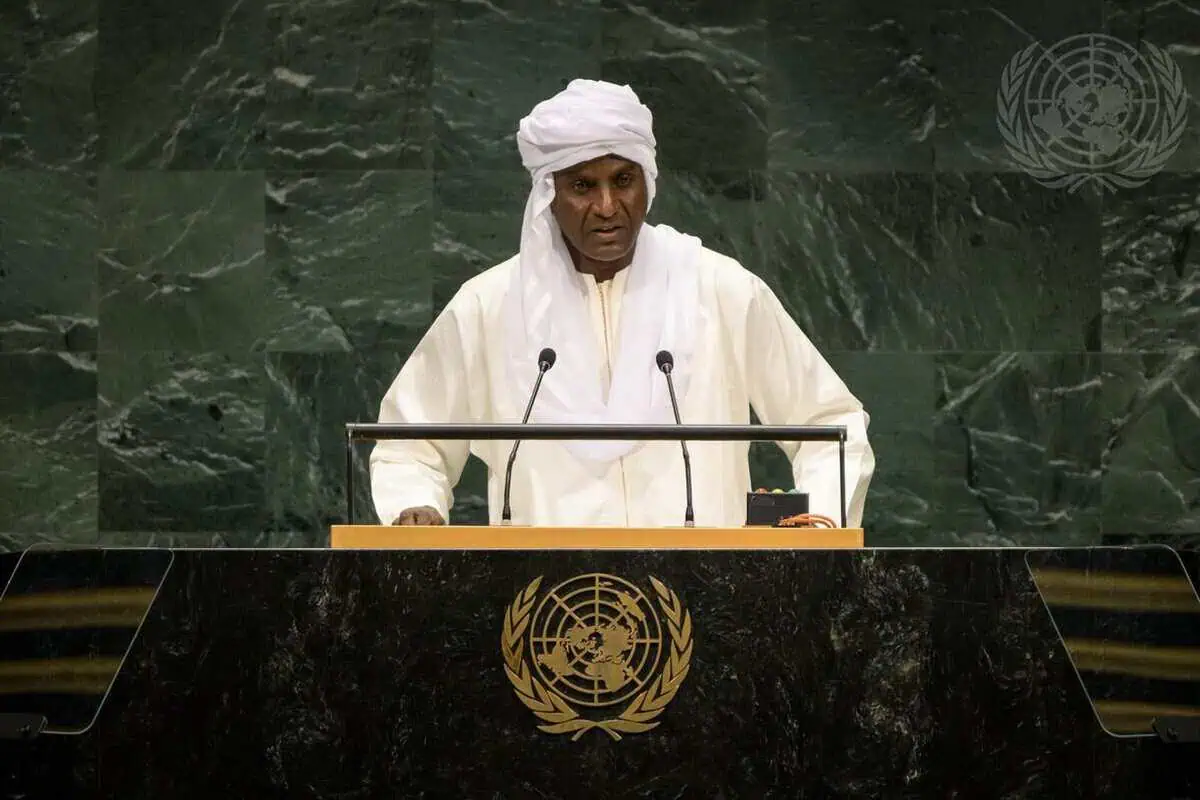
Nigerien Prime Minister Ali Mahaman Lamine Zeine portrayed his West African nation and neighboring military-run Sahel states as a last rampart of African independence against European neocolonialism in his speech on Friday, Sept. 25, at the General Assembly.
His remarks echoed his address at the high-level week last year, blaming most of his country’s problems on France, except that this year’s address singled out its northern neighbor Algeria for praise.
“The AES is to Africa, its historical and contemporary diasporas, what light is to darkness. It is a beacon of hope and dignity for this human community present in all four corners of the world,” he said, referring to the Alliance of Sahel States: Mali, Burkina Faso and Niger.
On Aug. 29-30, 2026, some Nigerien soldiers mutinied and attacked the main airport military base in the capital, Niamey, and the national TV station. Fighting broke out in the streets near the presidential palace between soldiers loyal to the current military government and soldiers criticizing the current government for poor governance and growing insecurity.
The government, led by a former head of the presidential guard, Gen. Abourahamane Tiani, defeated the mutinous soldiers with the help of Russian troops based in Niger. Zeine referenced the attack in his General Assembly speech, saying that “a third attempt at destabilization, led by obscurantist and colonialist forces, targeted our institutions. Like the previous ones, it failed, thanks to the loyalty of our Armed Forces.”
Niger has since reorganized its military hierarchy, including changing the chief of staff of the armed forces from a brigade general who was trained by the American military to someone closer to General Tiani.
General Tiani took power in a coup against the elected President Mohamed Bazoum in 2023 and has kept him in house arrest in Niamey since then, proclaiming himself as head of the “transitional government.” With no timeline on the length of the transition, critics have argued that he is aiming to remain head of state for the foreseeable future.
Although Algeria had condemned Tiani’s 2023 coup, it has increased ties with Niger in the last year. After the attempted August mutiny, Algeria sent four Sukhoi Su-30MKA fighter jets, a refueling tanker and a transport plane to Niamey in an unprecedented show of force and support for the Nigerien government.
Algeria reportedly intervened partly out of concern for the United Arab Emirates’ increasing engagement in the Sahel region and support for the military leader Khalifa Haftar in eastern Libya. He is accused of supporting rebel groups in northern Niger. Algeria severed diplomatic relations with the UAE on Sept. 10, 2026.
Indeed, toward the end of his speech, Zeine heaped praise on Algeria, saying that Niger “is standing on its own feet today because the People’s Democratic Republic of Algeria, a brotherly and neighboring country, has chosen to support it through substantial investment in the exploitation of its natural resources and through constant support for its defense system.
With Algeria, we also maintain dynamic cooperation in the fields of health, education, energy, water resources and agriculture.” — Dulcie Leimbach

Sweden’s Smart Alice
Sweden’s Minister for Foreign Affairs Maria Malmer Stenergard began her remarks to the 81st General Assembly, on Sept. 25, with a story about her grandmother, Alice, who grew up in rural Sweden and became an exemplar of women’s independence and financial literacy through her work at a local bank.
Through this anecdote, Stenergard emphasized that many women remain economically dependent on men, arguing that “women’s economic empowerment is a matter of freedom.” Referencing her grandmother, she noted that both Sweden and Afghanistan granted women the right to vote in 1919, yet the contrast in women’s freedoms between the two countries is now stark.


“Freedoms do not defend themselves. It is up to us to protect them, for women and girls everywhere,” she said.
Stenegard connected those rights to growing global challenges to sovereignty and territorial integrity, pointing to the rising number of armed conflicts and civilian suffering in a range of places, including Ukraine, Palestine, Lebanon, Sudan and the Democratic Republic of the Congo.
She focused most sharply on Russia’s four-year-old war in Ukraine, calling the invasion “a blatant violation of international law” and accusing Russia of violating the UN Charter, international humanitarian law and human rights law. She cited attacks on civilians, the forcible deportation of children, torture and conflict-related sexual violence.
“Ensuring accountability for these violations is crucial,” she said, arguing that “there cannot be a just and lasting peace without accountability.”
Addressing Russian President Vladimir Putin and Foreign Minister Sergey Lavrov directly, Stenergard said: “The path to peace is clear, the choice should be easy. Withdraw your troops. End this war.”
Stenergard also sought to reinforce Sweden’s longstanding relationship with the UN, pointing to the role of Swedish peacekeepers, mediators and development assistance in the organization. Sweden, she said, would remain “a staunch partner” while pushing for a UN that is “more effective, more transparent and better equipped to uphold the principles of its Charter.”
She ended with a quote by the late Secretary-General Dag Hammarskjold, another Swede, she said, “The weakness of one is the weakness of all, and the strength of one — not the military strength, but the real strength, the economic and social strength, the happiness of people — is indirectly the strength of all.” — Miriam Alrahil

China Stands Up for Gaza and Cuba
Chinese Vice President Han Zheng addressed the 81st session of the General Assembly on Saturday, soon after Chinese President Xi Jinping’s state visit with President Trump at the White House this week.
During the Washington summit, Xi emphasized the need for China and the US to “co-exist in peace,” saying that both countries can gain from cooperation but lose from confrontation. Against this backdrop, Han’s 12-minute speech on Sept. 26 echoed Xi’s message, with peace at its center.
Han called for greater international cooperation and the preservation of peace amid growing geopolitical tensions and global challenges. He emphasized the importance of the UN-centered international system and international law, calling on countries to resolve disputes through dialogue and consultation rather than military action.
Regarding the Mideast, Han advocated for respecting the sovereignty and security of countries in the region. He called for Gaza’s postwar reconstruction to follow the principle of “Palestinians governing Palestine” and urged a return to the path of a two-state solution. A year ago, 142 countries in the General Assembly endorsed a declaration to reinforce the longstanding but unacted approach to the Israeli-Palestinian conflict.
Han also addressed Cuba, which has endured a decades-old US embargo as well as new punishing economic measures by the US. He called for the US to end threats of force against Cuba and urged the immediate, complete lifting of the blockade and sanctions imposed by the US on the Caribbean country. His remarks reflected Beijing’s broader emphasis on avoiding confrontation and promoting stability in its relations with Washington.
On global development, an overriding focus of China at the UN, Han highlighted the matters of poverty reduction, food security, energy transition and climate finance across the world. In China’s role as a major voice of the global South, Han called for more financial and other support for developing countries and emphasized maintaining global trade and stable supply chains.
Despite AI being a focus of many leaders’ speeches at the General Assembly this week, Han did not go into detail about it, even though China and the US are both racing ahead with development. He did call for a human-centered approach to AI and reducing the digital divide.
China, said, will continue to support multilateralism and cooperate with other countries to promote peace and a more equitable system of global governance. — Jiyan Kisanak