







Finnish President Alexander Stubb asked ChatGPT to assess Kenyan President William Ruto’s initiative on artificial intelligence during a recent event on how middle powers are engaging with frontier technology. The chatbot described the initiative with its usual flattery but added that its success will depend on persuasive actions.
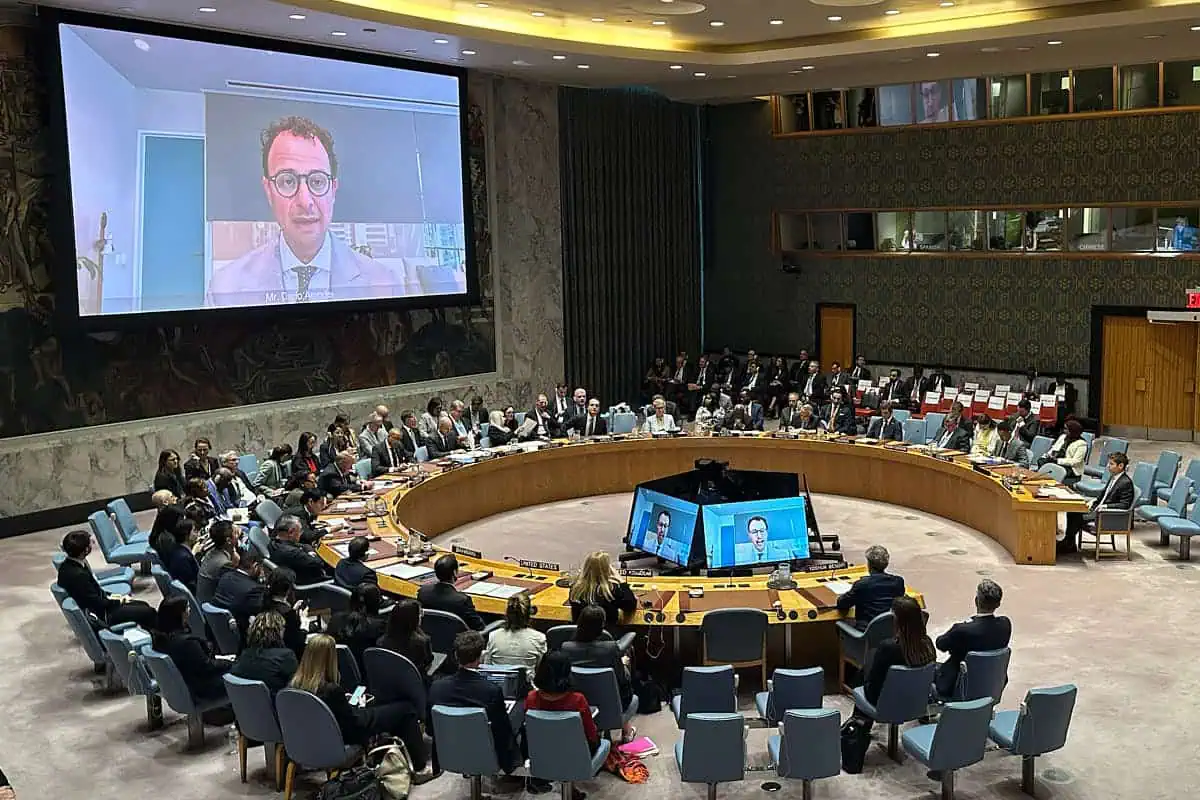
Dozens of AI-related forums were held as world leaders converged at the United Nations headquarters for the 81st session of the General Assembly high-level session last week. The meetings on AI — numerous and wide ranging — included a major one in the Security Council with the chief executives of the two leading American AI companies, Anthropic and OpenAI, participating.
Most of the UN gatherings focused on how to mitigate risks of AI from becoming more rampant through mishaps in labs while harnessing benefits of the new technology. The UN itself used the week to launch its own initiatives, including a blueprint for national AI strategies.
Yet all the conversations, demands and structures are happening as most global South countries, where about 85 percent of the world’s population lives, are still struggling with the basic necessities of the technology era. That includes national electrification grids and other requirements of the digital age, such as access to computers, phones and the Internet.
Lesotho Prime Minister Sam Matekane said on Sept. 21 at a UN digital-cooperation event, that the AI divide was no longer defined solely by access but increasingly by whether countries will ever have the computing capacity, data, skills and institutions required to govern and benefit from AI.
“Like many countries, we have a data center, but possessing a data center is not the same as being prepared for AI,” Matekane said.
His assessment of what Africa needs to benefit from the new technology is on the mark, experts say, but Lesotho, the first African country to pilot the UN Blueprint for National AI and Data Strategies, a voluntary tool, is, like many other countries in the global South, far behind on all the indices Matekane listed.
At least 59 percent of households in tiny, landlocked Lesotho still lack electricity, and the country may not reach universal access even by 2030, according to the World Bank. Yet it has one of the highest literacy rates in the continent.
On the other side of the continent, Internet access in Guinea, the second African country to adopt the UN blueprint, is below 35 percent. And in Senegal and Mauritania, who are also trying out the blueprint, only 60.1 and 45.8 percent of their respective populations use the Internet.
“Many countries on the continent lack the infrastructure and foundational laws that are required,” said Samuel Segun, an AI safety expert affiliated with the African Hub on AI Safety, Peace and Security at the University of Cape Town. “So the blueprint could help countries to identify how to connect their AI ambition with actual national conditions for energy, connectivity, data, governance and institutional capacity.”
Behind the curve
Other experts say that many of the countries turning to the UN, multilateral organizations and the AI superpowers for policy directions are already behind the development curve. Lesotho’s plans for applying the UN blueprint involved setting up a subcommittee to oversee AI coordination among ministries as it named its Minister of Information, Communication, Science and Technology the government’s “digital officer” after a five-day “working session.”


According to Matekane, the first phase of implementation would take three years, from 2026 to 2029.
In today’s AI world, where frontier labs are launching models at record speed, bureaucratic activities such as organizing working sessions and setting up community groups and implementation across years will further widen development gaps, observers note.
Claire Melamed, the vice president on AI and digital cooperation strategy at the UN Foundation, a nonprofit group, told PassBlue that the UN can establish norms, increase transparency, set expectations and create a crisis-response tool for countries lacking adequate AI safety-monitoring institutions. But it is the governments that must prepare their own tax systems, labor markets, media rules and public institutions to manage the influence of AI.
“Those are the things that are going to determine how people experience the effect of AI on their lives,” Melamed said.
As of June 2026, Africa had two systems — one in South Africa and another in Morocco — listed in the Top 500 ranking of the world’s most-powerful supercomputers, capable of performing vast numbers of calculations for advanced scientific research and artificial-intelligence development.
An estimated 6.8 billion of the 8 billion people in the world currently live in low- and middle-income countries, yet they host only 23 percent of global commercial data centers. Low-income countries account for less than 0.1 percent, according to the World Bank.
Joseph Nganga, the founder of Africa Climate and Energy Nexus (AfCen), speaking during an AI and middle-power high-level event during the recent General Assembly high-level week, said that it takes more than eight years to develop an AI data site in Africa. An Anthropic representative at the discussion quickly pointed out that governments generally would need to accelerate physical infrastructure and computing ability to gain from the technology.
Michael Sellitto, the Anthropic official, said that though it would take eight years to build a data center in Africa, a similar project in the US would take only 9 to 18 months.
“Elon Musk is building a single data center that has twice the capacity of all of the continent of Africa,” Sellitto added.
Where’s the money?
The boom in AI use came with the launch of ChatGPT in 2022, but the research that gave birth to the technology has been the focus of computer scientists for decades. Researchers in China and the US, the two leading countries in AI technology and backed by robust government and private funding, spent years studying automation, building capacity in control engineering and experimenting on earlier iterations of large language models.
Vukosi Marivate, the director of the University of Pretoria’s African Institute for Data Science and Artificial Intelligence (AfriDSAI), argued that a few universities on the continent were conducting theoretical and applied AI research decades before chatbots and agentic AI became mainstream, but the work was held back by too little funding from governments and the private sector.
Private AI investment in the US and China reached about $757.3 billion and $131.8 billion respectively, between 2013 and 2025, according to the Stanford University’s 2026 AI Index. By comparison, no African country has met the African Union’s one percent of GDP benchmark for general research and development.
“As a result, ” Marivate said, “countries often end up catching up after new technologies emerge instead of preparing in advance.”
The amount of global AI investment is expected to exceed $1 trillion in 2026, with more than half of the money concentrated in the US, according to Anna Sophie Herken, the managing director of the German development agency GIZ.
AI startups in Africa raised an estimated $1.25 billion from 2019 to 2025, and 80 percent went to companies in just four countries in the continent’s main quadrants: South Africa, Nigeria, Kenya and Egypt, according to Herken.
UN Secretary-General António Guterres has proposed an initial $3 billion global fund for AI capacity building, disbursed over two to four years to global South countries, but that would establish only a minimum resource in a handful of states. With his term ending on Dec. 31 and a new UN leader stepping in the next day, it is difficult to say how much the UN will continue to support AI funding and provide guardrail guidance for member states.
Multilateralism v. local actions
Governments from Africa, Asia, Latin America and the Caribbean are joining coalitions across a range of multilateral institutions, but the work carrying out the informal agreements is mostly fragmented. At least 30 states used the recent General Assembly high-level session to announce a group aiming for transparent AI safety protocols, coordinated government standards and international verification.
“We should avoid creating modern colonialism that broadens gaps between countries and societies,” Alexander Stubb, the Finnish president, said as he pushed the need for a cross-regional agreement on AI.
Mexico participated in two regional AI-ethics summits, one in Santiago, Chile, in October 2023, and another in Montevideo, Uruguay, in October 2024. In 2025, it also successfully pushed through a UN General Assembly resolution addressing the use of AI in nuclear command-and-control systems. At home, however, Mexico has yet to pass a comprehensive federal AI law. Instead, it is relying on existing laws regarding consumer and data protection, which do not adequately regulate AI and its use.
Indonesia, one of the largest economies in Southeast Asia, has spent the last seven months trying to amend its 2014 Copyright Law to accommodate the new realities of artificial intelligence while it grapples with sexual deepfakes and other forms of malicious digital fabrication.
At the UN, Nigeria, Africa’s most-populous country, with over 240 million people, supported both the respective US and China-led AI resolutions in the General Assembly in 2024 and signed last year’s Paris AI Action Summit statement on capacity-building for developing countries.
But Nigeria’s Artificial Intelligence bill, focusing on regulating the tech’s development, deployment and use, is still under legislative reading 19 months after it was put on the table. Meanwhile, Nigerians increasingly rely on AI chatbots for medical information amid shortages of professional care. And the country’s Independent National Electoral Commission, or INEC, is warning that AI-fabricated election results could threaten the January 2027 elections.
Cyrus Hodes, the founder of the advocacy platform AI Safety Connect, which was born at the Paris AI summit, gathered more than two dozen world leaders and experts over several days on the sidelines of the General Assembly high-level week to debate the risks of the technology. Most of the conversations focused on how to mitigate dangers in the countries that are leading the development of AI.
“The global North itself is not ready to deal with the risks, that’s why we are sounding all the alarms,” Hodes told PassBlue on Sept. 25.
Mayowa Tijani, an AI researcher at Northumbria University in Britain and director of projects at the Cable Newspaper Journalism Foundation, voice some cautious optimism. “Many of the people I have spoken to in my research share a sense of helplessness,” he said.“They reckon that we lost the war in the past industrial revolutions.”
But if government or private players, he noted, can properly invest in local development and regulation, the global majority may have a fighting chance.









Damilola, thank you for the reflection, however, I will caution about AI in Africa because it will be useful to be careful and selective because we are talking about AI in a young population setting and AI in the West and China where the population is old and declining! Last week in Mali the President Assimi Goita has opened a National AI and Robotic Center for training and production!