







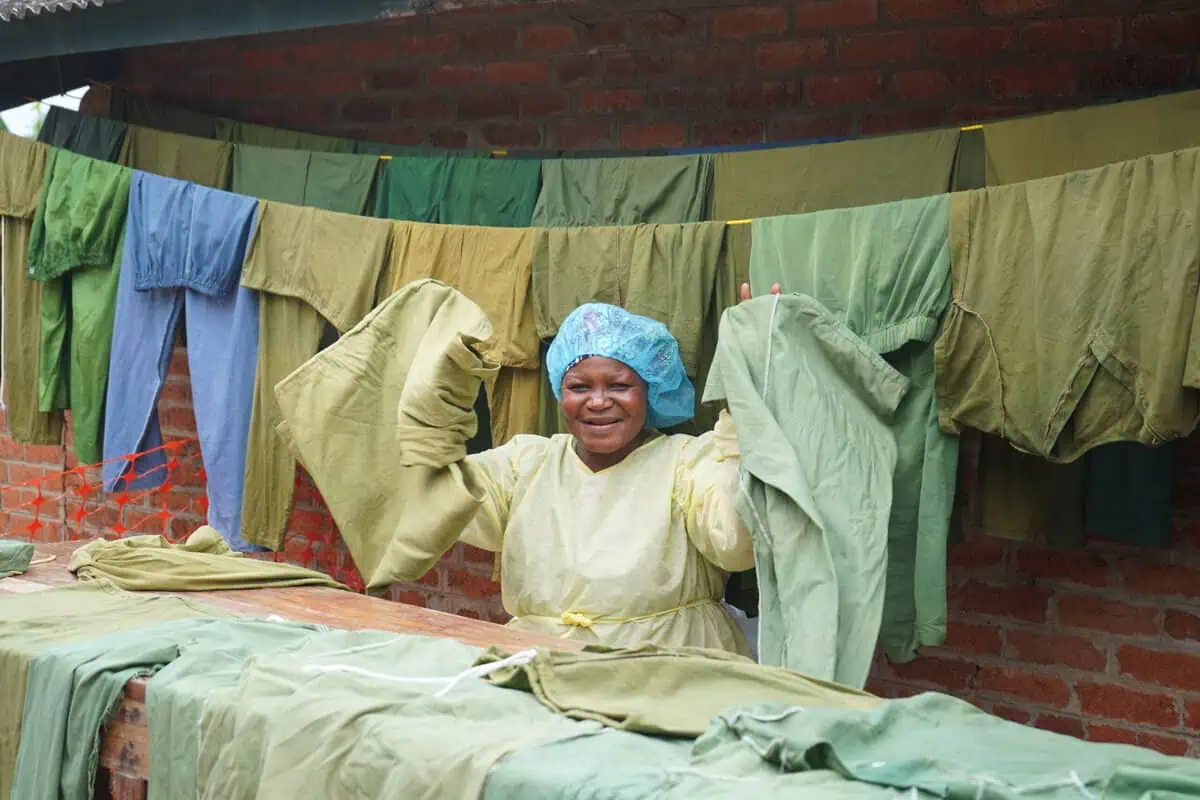
When the Marburg virus hit Rwanda in September 2024, the country’s No. 1 goal was stopping community transmission. Marburg, in the same family as the Ebola virus, is second among the top-four deadliest viruses in the world. More than 80 percent of people who contract the disease die.
The country tracked the source of the zoonotic disease, and using genomic sequencing, sequenced the virus. They discovered that the outbreak was closely related to a sequence that happened in an outbreak of Marburg in Uganda in 2014.
Rwanda mounted an ambitious response by beginning contact tracing, mass testing and surveillance. Ultimately, 9.6 million people were screened by about 54,000 community health workers.
From the diagnosis of the first case of Marburg to the deployment of the first shot of the experimental Sabin Vaccine Institute inoculation was 10 days. The case fatality rate for the outbreak stayed at 22 percent, the lowest ever recorded for the virus.
Two years on, across the border from Rwanda, the Democratic Republic of the Congo (DRC), has entered Day 139 of its fight against a new strain of an Ebola outbreak, called Bundibugyo. Approximately 3,700 people have died since the outbreak was declared in mid-May 2026. The first encouraging signs of progress to fight it may be emerging.
Rwanda’s response to the Marburg outbreak, hailed the world over, was possible because the country had spent years preparing for such an epidemic. But the DRC is trying to build responses in altogether different conditions: It is coping with a humanitarian crisis amid a war.
So the burning question that dominated the UN’s pandemic preparedness meetings at the General Assembly high-level session last week was: Is the world willing and able to pay for readiness now?
On the ground in DRC
According to the WHO, from Aug. 31 to Sept. 20, the cases of Ebola in the DRC declined by approximately 26 percent at the epicenter, Ituri Province. However, in the same period, North Kivu Province, near Ituri, recorded a 73 percent increase, evidence that the outbreak was evolving across the numerous affected areas.
“Each of the seven affected provinces has its own transmission pattern. One of our greatest concerns is that too many people are still dying before reaching treatment,” said Dr. Marie Roseline Belizaire, the regional emergency director for WHO Africa. She was speaking by Zoom at a recent UN briefing on the Ebola outbreak in eastern DRC and emergency preparedness ahead of El Niño and other health emergencies in the region.
“Every death in the community also increases the risk of further transmission among family members, caregivers, and others involved in burial practices, and although adults account for most confirmed cases,” Dr. Belizaire added. “Children are especially vulnerable.”
On the ground in the DRC, she said that all response teams are working closely with communities to identify suspected cases quickly and to address the misinformation that is keeping people from seeking appropriate care. The bigger emphasis has been moving the response away from major urban centers into rural areas, where the most-worrying epidemiologic trends are occurring.
The needs are enormous.

Money, time and a plan
“The problem is multifaceted,” Dr. Catherine Smallwood, a WHO incident manager for the Ebola response in North Kivu, said in the recent UN event. “There is the access one, and there’s also the issue of funding. We need partners. We need time, we need money, we have a plan, and if we really, truly want to be able to stop this epidemic in the next six months, we will need additional resources.”


For both Rwanda and the DRC, the realities of fighting the Bundibugyo strain are vastly distinct. Rwanda’s health minister, Yvan Butera, spoke at an event during the UN high-level week hosted by the Pandemic Fund, which focuses on pandemic prevention, preparedness and response in low- and middle-income countries, and the governments of Armenia and Rwanda. The forum spotlighted how countries are investing their own resources to close critical preparedness gaps.
Butera said that building a readiness-response plan cannot be done in the middle of a war and humanitarian disaster.
The DRC’s effort to control the Ebola outbreak is still lacking an approved vaccine. Provisions of other essential health services are also being carried out under sometimes deadly circumstances.
The services include maternal health, routine immunizations, treatments of malaria and other baseline conditions resulting from widespread displacement of civilians. The decades-long conflict in the eastern DRC involves the M23 militia from Rwanda fighting Congolese troops in competition for the area’s mineral wealth. The violence has made the Ebola outbreak hard to contain.
As of Sept. 30, 2026, data from the Congolese authorities confirmed a total of 3,901 deaths out of 8,067 confirmed cases in the DRC from the outbreak. It has surpassed previous records to become the largest Ebola outbreak in the history of the DRC, but it has not spread to Rwanda. In May 2026, it spread into neighboring Uganda through infected cross-border travelers, but its government halted transmission and was officially declared virus-free by the WHO in August 2026.
Lessons from Covid-19
Six years ago, the Covid-19 pandemic devastated global health systems, and many countries have yet to fully recover. Mathematical modeling by the Center for Global Development, a nongovernmental organization focused on reducing poverty, suggests that the likelihood of another pandemic of the same scale as Covid within the next 25 years will hit nearly 70 percent. Many global health experts believe the odds are climbing closer to a full certainty.
But the world moves on too quickly, said Wessam Mankoula, the acting head of Emergency Preparedness and Response Division for Africa Centers for Disease Control and Prevention, or Africa CDC.
“SARS is over and we forgot, Covid-19 came, we’ve forgotten the devastation,” Mankoula said in a panel on building resilience during last week’s UN General Assembly session. “We need to invest more to build resilient systems now. And to ensure sustainability of our efforts, in the DRC and everywhere else we have to first fight our serious case of pandemic Alzheimer’s.”
Mankoula’s work involves generating resources for the Pandemic Fund to remedy the Ebola outbreak in the DRC. His team is aiming for a fast turnaround of financial pledges into disbursement.
“In the first two months of the response in DRC, we had 10 to 20 percent success moving from pledges to disbursement,” he said. “The impact was that the first response plan for DRC was $240 million and the second response plan was $1.3 billion. So when there is a delay in dispersing resources, the cost of responding to an emergency dramatically increases.”
According to media reports, $2.9 billion has been raised so far, based on AFrica CDC numbers.
Success, Mankoula added, is when the CDC’s support is no longer needed because countries got their pandemic readiness done in “peace time.”
The World Bank operates the Pandemic Fund, whose largest contributors are the US, the European Commission, Germany, Italy and Japan.
“The World Bank and the Pandemic Fund’s priorities are clear. Invest early, invest together, and be ready to act,” Paschal Donohoe, the managing director and chief knowledge officer at the World Bank said at the General Assembly event.
“We learned from the pandemic [Covid-19] that countries that depended on others for the tools that they needed to survive paid a price,” he added.
Yet at another UN meeting on pandemic preparedness, the US last week rejected a UN declaration pledging global solidarity on pandemic preparedness. The US said it was “not in a position” to support the text. The European Union also had strong objections.
The US also withdrew from the WHO in January, after dismantling USAID last year.
“It would be extraordinarily difficult in almost any funding environment,” Dr. Cecilia Mundaca Shah, vice president of global health at the UN Foundation, said, referring to the current circumstances of fighting the disease amid funding pullbacks.
“But it is fair to say that the crisis in the DRC unfolding alongside the present funding climate is definitely being felt.”
For Africa, the next pandemic — which is surely coming, experts say — may show that the continent is not readier than it was when Covid-19 swept the earth.









Olivia thank you for this useful contribution, my conclusion is a simple one: to be ready for the next pandemic, the world and Africa specially have to transform the ONE HEALTH concept humans-animals-environment into the public health reality and build resilient inclusive health systems around it harnessing innovation and technological advances. Let us get out of the silos thinking, understand that pathogens do not know borders and do not need visas to travel to invest together in the ONE HEALTH approach as the way forward because that is the lesson the world and Africa have to learn from COVID19, Ebola, Marburg, Cholera, etc epidemics and pandemics.