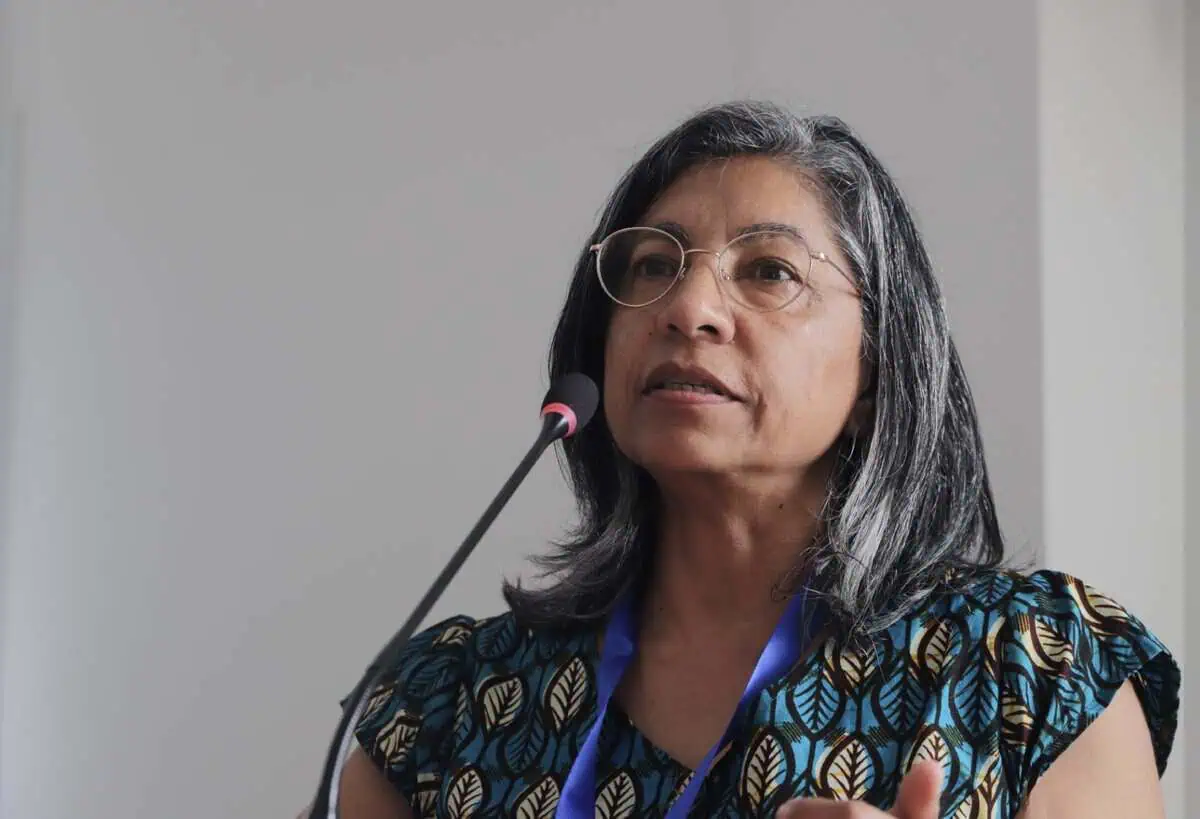
As the United Nations continues its search for a new leader, Binaifer Nowrojee, president of the nonprofit Open Society Foundations, described the kind of secretary-general that the world wants. But is it the same person that the five permanent members of the Security Council — Britain, China, France, Russia and the US — want, PassBlue asked her.
“We need a secretary-general that is bold, that is not scared to speak truth to power,” Nowrojee told PassBlue on Sept. 24, during an interview that touched on many global issues, including the race to choose the UN’s next top diplomat.
The 15-member Security Council ultimately recommends a candidate to the General Assembly for approval this year, as planned. But the process is currently going through an informal straw-poll phase to assess its candidate of choice.
The latest poll was held by the Council on Sept. 29, after three in July, August and early September, respectively, and like the others before it, the P5, as they are known, have yet to publicly show their hands on who they want to lead the 81-year-old UN. Each P5 has a veto, which can block a substantive Council decision despite majority support and thus end a candidate’s aspirations. A nominee needs to have at least nine votes from the Council and no veto to win the coveted recommendation to the Assembly.
Aglaia Balta, Greece’s permanent representative to the UN and the Council’s monthly rotating president, said on Oct. 1 that members would be consulted on using color-coded ballots in the next two straw polls, slated for midmonth and end of the month. The color ballots distinguish the P5’s votes from those of the 10 elected members, revealing whether a candidate faces opposition from a permanent member without identifying which country cast the no vote.
The candidates, now numbering seven, after Michelle Bachelet of Chile dropped out on Sept. 20, have been straddling a tightrope in their respective campaigns, avoiding statements that could put them at crossroads with the P5. Despite the balancing act, some P5 have publicly signaled reservations about candidates. Bachelet, Chile’s two-time president, announced her withdrawal after poor results in the first three informal ballots.
Opposition from Washington was a hurdle she could not surmount because of her perceived pro-abortion stance and other matters. (Relevant US officials, for starters, never met with her, according to a diplomat familiar with her campaign.) China has said it would prefer a woman secretary-general. That could complicate the bids of candidates like Rafael Grossi of Argentina, Macky Sall of Senegal and Olara Otunnu of Uganda. Grossi also faces a potential block from Russia, which has reportedly suggested it may oppose candidates with European Union or NATO citizenship.
Besides being Argentine, Grossi holds Italian citizenship. Maria Fernanda Espinosa, a candidate who is a former vice president of Ecuador and is backed by Antigua and Barbuda, has Spanish citizenship. So far, Rebeca Grynspan of Costa Rica and Guyana’s Carolyn Rodrigues Birkett have led the informal polls, but neither has emerged as an obvious consensus choice for the Council to recommend to the General Assembly. Color-coded ballots will better reveal their chances.
The interview has been edited for clarity and condensed for brevity. Some questions have been reordered for better flow.
PassBlue: Given the UN’s financial crisis, political tensions and struggles to resolve conflicts and fund development work, would a woman secretary-general step onto a glass cliff?
Binaifer: The United Nations has carried us well for the last 80-plus years, and there’s been great steps forward on a variety of issues through the UN and a rules-based world order, and people still want that. Governments still want that, but we are now at a point where the world is different. When the UN was set up, it was four or five empires that actually set it up and have presided over it. So there are inequalities and privileges that were built in that no longer fit today’s world.
Today, we don’t have a world of four or five empires. We have a world of 193 countries that sit and want a place at the table. Demographics are different. Eighty-five percent of the world’s population is now sitting in the global majority, only 15 percent in Europe and the United States. The UN has reached the end of how it can function in the way it’s functioned, and a reset is required, and that is the case for any organization.


The most important thing we need right now is a secretary-general who is visionary and bold and is ready to take this organization into the future. As the first woman to lead the Open Society Foundations, it is incredible to me that over 80 years, not a single woman has served as the UN secretary-general.
It is symbolic of the types of exclusions that have limited the abilities of the UN, even as it has espoused equality, even as it espoused human rights principles; it’s an important thing that it walks the talk internally of what it needs to do. We need a secretary-general who will lead us into the future that this next generation is going to live in.
PassBlue: What does the world need from the next secretary-general that might conflict with the P5’s priorities?
Binaifer: We need a secretary-general that is not scared to speak truth to power, that substantively can identify the key issues we need to focus on in this next century and is not scared to make some of the hard decisions that will require. We also need a secretary-general that is a bridge builder. They still have to work with member states. They still have to build coalitions around the agendas. But let’s not have a secretary- general that relinquishes the entire reform agenda and limits it only to budgets and headcounts. We have a once-in-a-lifetime opportunity to press a reset button. Let’s do it properly.
PassBlue: How do you see African countries engaging in multilateral, bilateral and trilateral AI discussions and using the technology?
Binaifer: First of all, we know Africa is the youngest continent, and every one of those young people has a phone in their hand, so we know that there’s a lot of familiarity and that young Africans are leaning into technology. They’ll lean into artificial intelligence. They may not be the architects of the structure, but they will be the users, and they will innovate and find ways to have this integrated into their lives.
What we want to ensure is that the harms that we are seeing in places where children or hate speech, those kinds of things, that African governments take steps to put in a regulatory environment, because now we know those lessons. We see Australia stopping social media for children under 16. We know that women politicians, for example, get much more hate and abuse online compared to male politicians. So African governments can actually make policy decisions to limit the harms but also benefit, to have their young people benefit from the good possibilities that that technology and artificial intelligence will bring.
PassBlue: How can African countries move beyond consuming technology to creating economic benefits for young people and for their national economies?
Binaifer: There’s huge innovation in Africa on many levels. Take a place like Kenya, where technology for money transfers with M-Pesa happened long before other countries were doing it, and you find very savvy tech people in Gen Z organizing protests on social media to call on the government to do things about their issues. We also see innovation in organizations like Gearbox in Kenya or others, and the difference between the US and Africa in terms of why does innovation actually appear in the US in the tech space. Because the US government has invested in providing funds for innovation.
Innovation doesn’t just pop out of thin air, and if African governments want to engage their citizens more and engage their young people with talent, they also need to invest in them, and I think that’s something that would be a priority for this moment.
PassBlue: With military governments recently emerging in parts of the Sahel region in West Africa, how can the African Union, other African states and the UN protect human rights gains, particularly for women?
Binaifer: I’m extremely hopeful about how African states and the African Union have been developing over the decades standards and discussions around human rights. Not everything is going well, and one can find examples. But if you look at the regional bodies that have been set up — the African Court [on Human and Peoples’ Rights], the African Commission [on Human and Peoples’ Rights], ECOWAS, the East African Court, these are all institutional structures, and now the job is to make them stronger and work better. So in many ways, Africa’s Banjul Charter, which turns 45 this year, is a starting point. And to say that Africa has had its own human rights framework, really for decades now, written by Africans for Africans, that doesn’t mean all is going well. What we need to look at is some of the issues where we can be doing better.
We know that about 40 percent of the world’s conflicts are in Africa, and we know that conflict drives some of the worst human rights abuses. I want to highlight the issue of Sudan, where sexual violence, killings, torture and starvation is used as a weapon of war, so these should be high on the agenda of the African Union to ensure that conflict is addressed. We also know Africa is very rich. It’s got critical minerals.
We want to see Africa use its critical minerals well, and we want to see the minerals beneath its soil translate into prosperity, dignity for Africans, wealth. That’s going to require policymakers to actually make contracts that benefit their people. It’s going to have to make sure that African-owned mines are able to negotiate. You’re going to have to make sure that communities that their environmental rights are protected and that we don’t destroy the continent in a bid to actually get wealthy.
I think that we also have an interesting phenomenon with Niger, Mali and Burkina Faso. Even as Africa is moving towards regional standards, we see these three countries responding to decades of injustice from colonialism and imperialism by stepping out of the existing structures and saying we want to do something different, including stepping out of ECOWAS, but I think we have to look closely because even as they are trying to say we want to be independent of historic forces, we don’t want to be in the shadow of a French colonial relationship.
But I think we have to look carefully at the result inside those countries [from their stepping out], because we are seeing increased conflict with civilians being targeted, we are seeing narrowing of space to speak, to organize, to take part in politics, all in the name of security. And when a government takes away the freedoms of its population in the name of security, you get neither security nor democracy, so I think that this is something that the heads of governments in Niger, Mali and Burkina Faso will need to address.
PassBlue: In the Democratic Republic of the Congo, how can communities living near critical mineral mines be protected from abuses and minerals kept out of armed groups’ hands?
Binaifer: This is no different from other conflicts. The first thing that we want to see is the international community and the African institutions, the African Union, making a concerted effort to end the hostilities and playing an active role in beginning to de-escalate violations. This requires diplomatic efforts, efforts to talk, but also protection efforts to ensure that communities that are affected can actually seek protection on the ground.
Communities themselves have to also organize and help communities to have their own voice. And where conflict has occurred, it’s very important that we look at the issue of accountability. We’ve seen a variety of types of justice mechanisms, be it a truth commission, or even within Africa, convictions, for instance, by the International Criminal Tribunal for Rwanda, around the top military and government perpetrators of genocide, so accountability is also important.