



About 32 million acres of South Pacific seabed off American Samoa are to be auctioned in November in the world’s first competitive lease sale for offshore critical minerals. The winning bidders will secure the rights to develop the zone’s minerals over a 20-year term.
On Oct. 20, the US Department of Interior’s Marine Minerals Administration (MMA), which oversees offshore mineral development, published the Final Leasing Notice confirming the auction date.
“A lease does not authorize extraction,” a spokesperson for the MMA told PassBlue, noting that any mining proposal would require “subsequent multiagency environmental and regulatory reviews.”
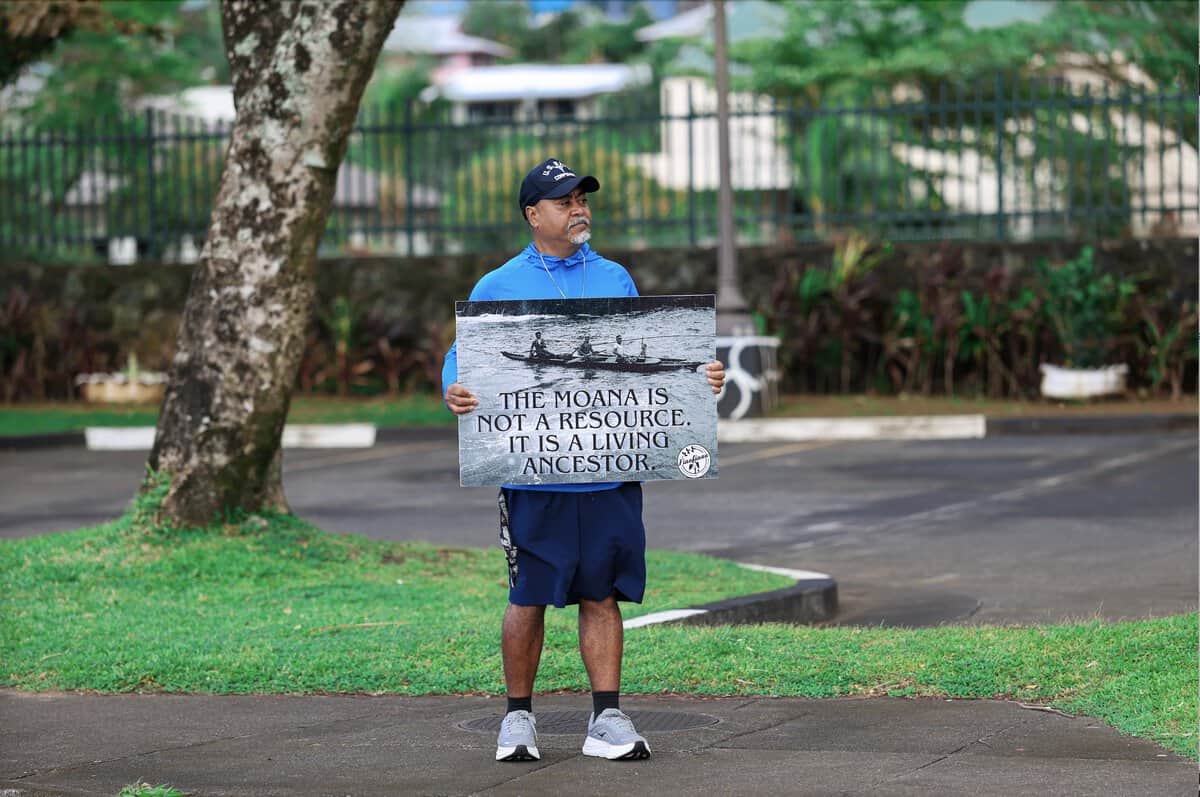
In American Samoa, civil society groups are opposing the auction, citing the risks that deep-sea mining poses to marine ecosystems and the local fishing economy. Their resistance reflects wider concern in the Pacific, including large nations like Mexico, also affected by the US drive to dig into the seabed.
A council of matai (chiefs or leaders) from American Samoa recently joined with two community groups to file a lawsuit in a US federal court seeking to block the Nov. 19 lease sale that would allow deep-sea mining off the territory’s coast.
The sale follows an April 24, 2025, executive order by US President Trump that framed seabed minerals like copper, cobalt, manganese and nickel as vital to national security. It directed federal agencies to fast-track deep-sea mining both in international waters and on the US Outer Continental Shelf, the federally managed waters beyond three nautical miles off state and territorial shores.
On April 8, just weeks before the executive order was signed, a US company, Impossible Metals, submitted an unsolicited request for a commercial lease sale off American Samoa to the Bureau of Ocean Energy Management, which oversaw offshore leasing before it was incorporated into the MMA in July 2026. Interest from “several other companies” during the formal lease evaluation led the agency to expand the lease area and split it into two blocks.
Unlike the independent nation of Samoa to its west, American Samoa is an unincorporated, unorganized US territory. Although it has been listed by the United Nations as a non-self-governing territory since 1946, its locally elected government banned seabed mining in its territorial waters in July 2024. That jurisdiction, however, ends at three nautical miles offshore.
The General Assembly approved a resolution in December 2025, as it generally does every year, on the “question of American Samoa,” noting that, among other matters, it was “concerned by the use and exploitation of the natural resources of the Non-Self-Governing Territories by the administering Powers for their benefit. . . .” (At committee level, the Assembly voted on a similar resolution last week, with only the US and Israel voting against it.)
The lease areas lie beyond the offshore boundary on the Outer Continental Shelf. As part of the federal leasing process, American Samoa’s Governor Pulaali’i Nikolao Pula can comment on the sale’s terms, but he cannot block the auction. In a Sept. 15 statement to the Bureau of Ocean Energy Management, Pula said that his administration did not currently support commercial deep-sea mineral extraction. His office did not respond to PassBlue’s request for comment.
American Samoa consists of seven islands, two coral atolls and a population of about 46,000. Deeply rooted in Samoan tradition, the ocean remains central to livelihoods, with the tuna industry supporting about 83 percent of private-sector jobs, mostly using labor from neighbouring Samoa.
“The ocean doesn’t just surround American Samoa; it is part of who we are,” Sabrina Suluai-Mahuka, a founder of the local environmental organization Finafinau, told PassBlue. “We should not become the testing ground for an industry that has never operated commercially at this scale anywhere in the world.”


The lease areas are located about 70 nautical miles from the Rose Atoll, a wildlife refuge and national marine monument. The waters host a rich ecosystem, ranging from rare coral reefs and tuna stocks to sharks, whales and sea turtles protected under the US Endangered Species Act.
Deep-sea mining could endanger these animals’ habitat and disturb their migratory routes. Its impact on marine life remains poorly understood, yet research indicates ecological effects persist for decades. Documented problems include the destruction of fragile seafloor habitats, sediment plumes that travel for miles and suffocate marine life, noise and light pollution and toxic chemical releases.
In August, Fa’asao Amerika Samoa, a community group that works to protect Samoan culture and natural resources, and the Conservation Council for Hawai’i, an environmental nonprofit, sued the US National Marine Fisheries Service. The agency is responsible for managing marine species and, under the US Endangered Species Act, it assesses whether federal actions threaten protected animals. The plaintiffs argue that the agency‘s environmental review, a prerequisite for the lease sale, violated the US Endangered Species Act.
“We’re deeply worried deep-sea mining will harm our oceans,” Seumalu Elora Raymond, a founder of Fa’asao Amerika Samoa, told PassBlue, “and we want the US government to follow federal law.”

The upcoming lease sale in American Samoa and a second one off the Northern Mariana Islands, a US commonwealth in the western Pacific, proposed for December, targets federal waters outside the jurisdiction of the International Seabed Authority (ISA). Established under the UN Convention on the Law of the Sea (UNCLOS), the Jamaica-based ISA regulates the international seabed as the “common heritage of humankind.”
The US is also pursuing deep-sea mining within ISA-governed areas. Applications for US exploration licenses are underway for the Clarion-Clipperton Zone (CCZ), a stretch of international waters between Mexico and Hawaii. Located about 2,000 kilometers off Mexico’s west coast, mining there could threaten marine life in protected areas like Revillagigedo National Park.
Mexico has maintained a deep-sea mining moratorium since 2023. No exploitation activities are allowed in the zone until clear regulations ensure effective protection of the marine environment, a spokesperson of the Mexican Foreign Ministry told PassBlue.
At the latest ISA session in Kingston, in July, the coalition of nations backing a moratorium or precautionary pause on deep-sea mining grew to 46 from 43, representing more than a quarter of the organization’s 172 members.
Meanwhile the US, which holds observer status at the ISA, as it has never ratified UNCLOS, claims extraction rights under its Deep Seabed Hard Mineral Resources Act, a national law passed in 1980 as an interim measure to regulate deep-sea mining until an international regime took effect.
The ISA secretary-general, Leticia Carvalho, a Brazilian, has repeatedly warned that unilateral seabed mining would violate international law.
Alejandro Olivera, a senior representative for Mexico at the Center for Biological Diversity, a US-based conservation organization, said: “My greatest concern is what happens to the ISA when the US starts to extract unilaterally. If extraction begins outside the regime and the authority is left issuing statements, Mexico and other countries lose the only table where they have a voice over what happens off their coasts.”