







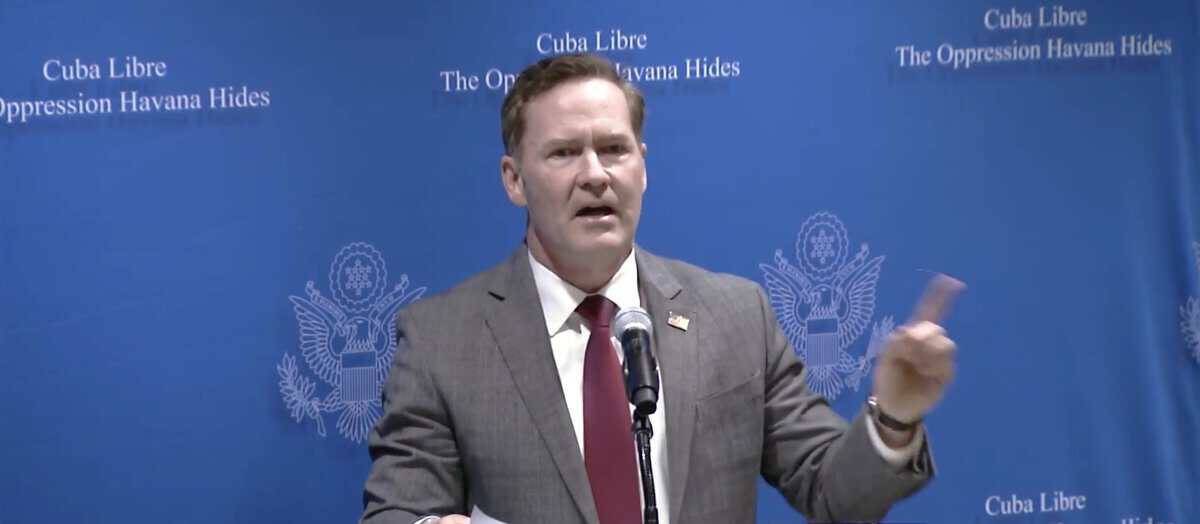
As Mike Waltz, US envoy to the United Nations, walked out with his entourage after a meeting he held in a windowless room in the first-basement level of the headquarters, he was greeted by rowdy chants led by the Cuban permanent representative to the UN.
The US meeting, titled “Cuba Libre: The Oppression Havana Hides,” focused on alleged human rights abuses in the Caribbean country, including the “unjust detention of political prisoners and the systemic exploitation of doctors and nurses via its medical missions program,” according to the concept note.
“Waltz is a ‘liar’!” a group led by Ernesto Soberón Guzmán, the Cuban envoy, shouted as Waltz and his retinue headed upstairs toward the Delegates Entrance and exit near 46th Street on First Avenue. “Terrorismo!” they also yelled.
The showdown on Monday, Oct. 19, was timed for the annual UN General Assembly debate and vote for the last three decades to condemn Washington’s economic and trade embargo against Cuba, which was first imposed in 1960. The Assembly is scheduled to hold the session on Oct. 27-28.
The invitation-only meeting hosted by Waltz was meant to persuade more UN member states to vote against the resolution condemning the embargo. Last year, the vote was 165 to 7 in favor of the resolution (with the US, Israel, Argentina, Paraguay, Hungary, North Macedonia and Ukraine voting against it).
This time around, Waltz met with about a dozen Latin American envoys last week — including from Honduras, Guatemala, Panama, Costa Rica, Ecuador and El Salvador — to possibly persuade them to vote with the US against Cuba, among other matters.
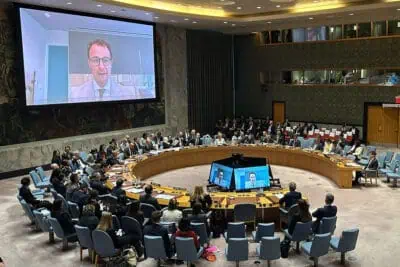
The US-led meeting on Oct. 19 was webcast live by the UN. It featured Cuban dissidents, US Rep. Nicole Malliotakis (R-NY) and Volodymyr Pavlichenko, deputy permanent representative of Ukraine. The dissidents accused Havana’s leadership of enriching themselves while citizens endure blackouts, food shortages and deteriorating health care. (Cuba says the US embargo is the source of these problems.)
Pavlichenko said that Cubans were among the 20,000 foreign nationals recruited by Russia to help fight its war in Ukraine, according to the Kyiv government.
“Please vote no,” Waltz told diplomats at the meeting, urging those unwilling to vote against the resolution to abstain or walk away.
The Assembly has been voting to condemn the US embargo against Cuba every year since 1992, except for 2020, when it was postponed until the following year because of the Covid-19 pandemic. While the nonbinding resolution typically receives overwhelming support from member states, Washington generally opposes the measure, saying the sanctions pressure Havana to carry out democratic reforms and to respect human rights.
Just outside UN Conference Room 6, where Waltz’s meeting was about to start, Guzmán, Cuba’s ambassador to the UN, held an initial gathering in the hallway with allies (like Russia) and others listening. He condemned the US event and accused Washington of promoting a false narrative to influence the Assembly vote next week. He called the US meeting a politically motivated “charade” and alleged that its use of UN premises for its invitation-only meeting violated the organization’s rules. He criticized the UN Secretariat for allowing the event despite objections from the Cuban mission.
The UN spokesperson did not respond to PassBlue’s request for comment by press time.
One dissident speaking at the meeting was Luis Manuel Otero Alcántara, a Cuban artist who said he had spent five years in prison before being forced into exile. He described more than 90 arrests in three years and said authorities treated independent artistic expression as a threat.


“Our crime was to do art, to write a song,” Alcántara said in Spanish.
Maria Werlau, a founder of a human rights organization called Cuba Archive, said the country’s overseas medical missions are marred by state coercion. Workers, she noted, face surveillance, separation from their families and confiscation of most of their earnings. Similarly, Malliotakis, who represents New York’s 11th congressional district (Staten Island and South Brooklyn), recounted how her mother’s family was separated after fleeing Cuba in 1959.
José Daniel Ferrer, a Cuban opposition leader and human rights activist, said he spent more than 12 years in prison, including long durations in solitary confinement. “When you vote in favor of that resolution, you are turning your backs on the Cuban people,” he added.
Guzmán accused Washington of inviting people with financial ties to the State Department, adding that the Trump administration was using human rights allegations to divert attention from the US blockade, which he described as collective punishment causing widespread suffering among Cubans.
“We will not surrender,” he told the crowd gathered around him in the UN lobby.









Great article and a big thank you Damilola. My conclusion is that what the US is doing in Cuba is a gross crime against humanity. The vote of the UN Assembly to condemn it since 1992 has not changed anything but more crimes from US against Cuba. Personally since 1982, I have known and worked with Cuban Medical Doctors in many parts of the World e.g. in Mali, the Caribbean (Haiti, Jamaica, Guyana, etc) and in Angola and what is said about them are falsehood and inaccuracies, they are very good professionals helping we the people under difficult situations in remote and rural areas. Everywhere they are respected for their professionalism. The US has to understand that there are many roads to Rome and it has to stop this eternal embargo against Cuba. Let me thank Cuba for its support to the development of the Global South through access to its great universities and professional schools by students from Africa and the Caribbean.