







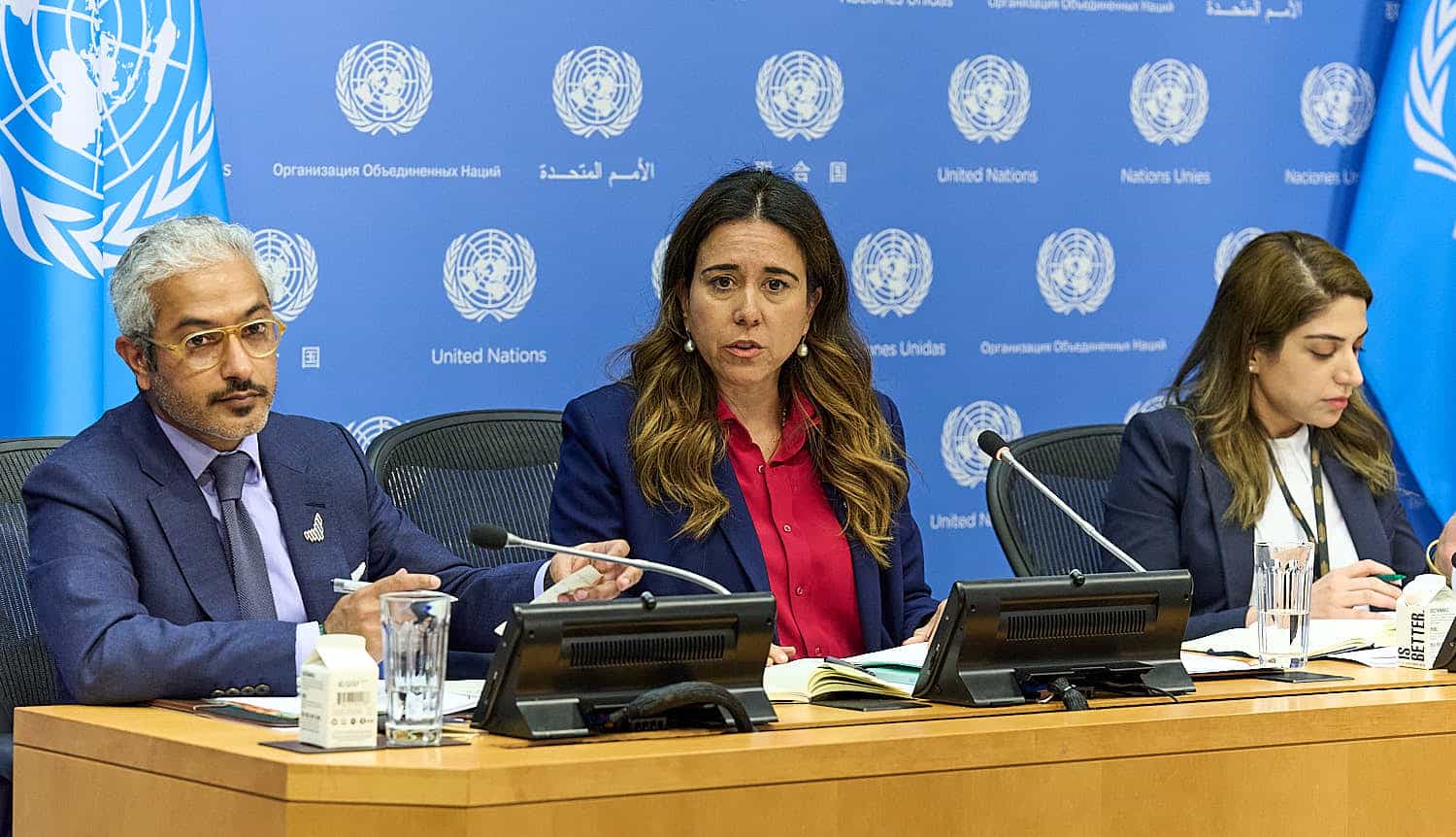
The United Arab Emirates has nominated Lana Nusseibeh for United Nations secretary-general, according to a report from the state-owned Emirates News Agency. Nusseibeh, the country’s first female ambassador to the UN, has been rumored for months as a potential candidate to jump into the race. Nusseibeh is UAE’s minister of state in the Ministry of Foreign Affairs and she joins six other candidates vying to be the top diplomat of the UN.
The news agency wrote: “His Highness Sheikh Mohamed bin Zayed Al Nahyan, President of the United Arab Emirates, submitted the nomination” as required as part of the UN secretary-general selection process. He is quoted as saying that “Nusseibeh’s deep experience of the United Nations, her judgement in addressing the ongoing international challenges, and her record of constructive work.”
The office of the President of the General Assembly would not confirm whether the required documentation for Nusseibeh’s nomination has been received, saying that Khalilur Rahman, who presides over the current session of the Assembly, is traveling. Yet PassBlue received a separate email from Teneo, a New York-based public relations company for the UAE Ministry of Foreign Affairs, confirming Nusseibeh’s nomination.
“I’m reaching out following today’s announcement of HE Lana Nusseibeh’s candidacy for UN Secretary-General,” Jan Hromadko, the managing director of Teneo, wrote in the email, enclosed with Nusseibeh’s vision statement.
In the statement, Nusseibeh wrote, in part, “The Charter gives the Secretary-General no army and no vote. But the position, held well, entails a different kind of power. Her independence empowers her to bring others to agreement, and that depends on trust. I will be the stubbornly optimistic, relentless diplomat I have always been in this endeavour.”
She added: “I take Article 100 of the UN Charter and the responsibility to act ‘with the interests of the United Nations only in view,’ extremely seriously. This is why, effective immediately I have taken a leave of absence from my position as Minister of State in the Ministry of Foreign Affairs of the United Arab Emirates. I wish to offer myself to this office as I would serve it: speaking frankly with every government and answering to none. There will be no exemptions for friends and no grudges against critics.”
Nusseibeh, born in 1978, entered the race late but as a well-known name in international circles from her time as a UN ambassador of the UAE, from 2013 to 2024, coupled with her country’s strong ties to the United States, a permanent member of the Security Council. Still, as a candidate, she will need to win over the other four veto-wielding permanent members — Britain, China, France and Russia — to her corner and defend her candidacy as UN secretary-general against Abu Dhabi’s controversial human rights records and role in the Sudan war.
A candidate requires at least nine votes from the 15-member Council and no veto from a P5 member, as they are called.
Human rights black marks
As a candidate, Nusseibeh will undoubtedly face scrutiny about the Emirates’ human rights record both in the country and beyond. Human Rights Watch’s 2026 report on the UAE describes severe restrictions on expression, association and assembly in the country, among other extensive criticisms.
Yet her father’s Palestinian roots could make her a viable candidate from certain quarters, and she defended Palestinian civilians’ need for humanitarian aid during Israel’s blockages of food and other essentials in Gaza when she represented the UAE in the Security Council, from 2022-2023, during the Gaza war.
Brett McGurk, who served in the Biden administration as a top national security adviser, tweeted on Oct. 21: “How did UAE become the largest global provider of humanitarian aid to Gaza, according to UN data? Because of Lana Nussaibeh — a diplomat who knows everyone and works with them to GSD. She would be an inspired choice for this impossible job.”
Her country’s other activities, however, draw scorn not only from an array of human rights groups but also from nongovernmental organizations focusing on conflicts and humanitarian crises.
Nathaniel Raymond, the executive director of the Humanitarian Research Lab at the Yale School of Public Health, said that if Nusseibeh becomes UN boss, it could be a “catastrophe” for the UN’s work in Sudan, Yemen and elsewhere in the Mideast and North Africa.


“She has a dual loyalty, conflict of interest, between the United Nations and a state which is credibly accused by the UN itself of directly aiding and abetting the massacre of El Fasher, which the UN itself has determined has the ‘hallmarks of genocide’,” Raymond said about Sudan.
In Sudan, the UAE has been accused by UN independent experts of arming and funding the paramilitary Rapid Support Forces (RSF), who are fighting the government army, Sudanese Armed Forces. Amnesty International reported in May 2025 that Chinese-guided bombs and howitzers used by the RSF were re-exported by the Emirates, breaching the arms embargo on Darfur.
The Emirati government rejected the findings and denied supplying weapons or military support to either side. Separately, the International Court of Justice dismissed Sudan’s case against the Emirates for lack of jurisdiction but did not resolve the underlying allegations.
“Next week is the one year anniversary of El Fasher,” Raymond added. “The UN should not celebrate it by making a government official of the country that made the massacre militarily possible the SG of the United Nations.”
Latin Americans on the edge
The selection process began officially about a year ago to find a successor to Secretary-General António Guterres, whose term ends on Dec. 31, 2026. As part of the procedure, the Council recommends a candidate to the General Assembly for final approval.
The current candidates have all gone through public hearings held by the 193-member General Assembly as well as numerous informal straw polls conducted by the Security Council. An early candidate, Michelle Bachelet, Chile’s two-time former president, could not recover from US criticism of her advocacy for women’s rights. She dropped out in late September.
Guyana’s Carolyn Rodrigues Birkett, in second place, is having to defend her government’s position on the Gaza war while assuring the Council (mostly, the US) that Guyana’s stance — that Israel has been defying international law in the conflict — would not influence her decisions if she is selected secretary-general. She’s finding that conversation hard to balance.
In the series of six straw polls held by the Council, none of the candidates have drawn consensus from the members. The top three (Rebeca Grynspan of Costa Rica, Rodrigues Birkett and Rafael Grossi of Argentina) each drew two “discourage” votes from a P5 member in the latest poll (on Oct. 16), yet the results do not imply an end to their candidacies, some experts say. They suggest, however, that the nominees must do more negotiating to overcome the initial “red cards,” as one African diplomat put it.
Nusseibeh’s nomination gives the Council, particularly the P5, another option while adding another woman to the race, now totaling four. The UN has never had a woman secretary-general, an 81-year gap that this contest was supposed to rectify, according to a General Assembly resolution.
The race was also meant to be the unofficial turn of the Latin America-Caribbean region to clinch the leadership post. Nusseibeh and another candidate, Olara Otunnu of Uganda, throw off that potential. (Macky Sall of Senegal recently dropped out of the race.)
Ricard Moscoso, deputy permanent representative of Panama (a Council member) has been vocal about his region’s turn, tweeting recently, “The veto wielding powers may not care, but any other new candidate will have to go through a round of color coded plus the General Assembly public scrutiny in the dialogues and Council Informal dialogues.” (The color-coded ballots started in the Oct. 16 poll, revealing “discourage” and “encourage” votes from a P5 member.)
A straw poll that was expected to occur on Friday, Oct. 23, was postponed to possibly next week to give the UAE time to submit Nusseibeh’s nomination, sources told PassBlue. Rahman, the president of the General Assembly, has also apparently different modalities in mind for upcoming interactive dialogues than the previous ones.
“The President of the Assembly has reiterated his pledge that any new candidate who may emerge will be introduced to the wider UN membership, in line with the relevant revitalization resolutions,” Melissa Summers, Rahman’s spokesperson, told PassBlue in an email on Oct. 21.
The other candidates are Olara Otunnu, a former UN official from Uganda; María Fernanda Espinosa, an ex-General Assembly president from Ecuador; and Ivonne A-Baki, a politician from Ecuador.
Jessica Le Masurier contributed reporting for this article.









Africa and the rest of the world have to respect Latin America and the Caribbean and give them the opportunity to access and exercise their experience and knowledge as the Secretary General of the United Nations!
Dulcie a big thank you for this contribution, my conclusion is simple, this is another game and another distraction which is bringing a lack of respect for the UN as an organisation and a lack of trust in the UN processes. Honestly speaking, Africa or the Middle-East should not have presented a candidate this time around as we all know that it is the turn of Latin America and the Caribbean to make this contribution to our organisation, can we not respect that tacite rule and work together to elect the best candidate from that LAC region who can better serve we the people!