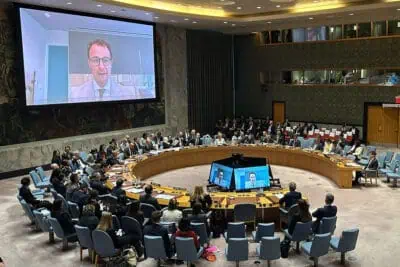
United Nations member states are scheduled to elect 10 new countries on Nov. 6 to the advisory committee on budgets, a 21-member body that holds immense influence over the organization’s finances but operates under the radar. Everyone needs to pay attention to the vote.
The ACABQ, or Advisory Committee on Administrative and Budgetary Questions, provides independent financial advice to the General Assembly’s own budget overseer, known as the Fifth Committee. The ACABQ’s members are elected by the Assembly to three-year terms, and their recommendations affect the allocation of resources across the UN’s three pillars: peace and security, development, and human rights.
The ACABQ, for example, helps to decide whether the UN allocates sufficient funding to pay investigators to document atrocities, to pay human rights experts to visit countries and to ensure that victims have access to international protection mechanisms.
This work includes UN inquiries into atrocities in Syria and Myanmar; UN committees receiving cases of individuals detained or disappeared; efforts to assist governments on achieving sustainable development; and addressing issues such as climate change and artificial intelligence.
But research published last year by the International Service for Human Rights (ISHR), a nongovernmental organization with offices in New York City and Geneva, exposed how seemingly technical budgetary processes have become a battleground for countries to weaken the UN’s overall human rights work.
The ISHR report documented how China and Russia have used budget negotiations to obstruct or reduce funding for human rights inquiries and mandates that have been previously agreed on by states, especially as the second Trump administration has withheld a large chunk of its mandated US dues, compounding the UN’s financial crisis.
Seemingly working in tandem, China has been building clout in less visible but highly important bodies in parts of the UN system, chiefly the ACABQ, while Russia has often sought to break consensus in budget talks and to draw out proceedings through disruptive proposals.
Lacking a consensus, countries are increasingly reverting to ACABQ recommendations, which have disproportionately targeted human rights. In the 2024 annual UN regular budget, 22.5 percent of ACABQ-proposed cuts targeted human rights, despite the costs representing less than 7 percent of the UN’s budget, excluding peacekeeping missions.
A mandate to investigate serious human rights violations will mean little without the money to carry it out.
From 2021 through 2025, the ACABQ rejected 124 of the 312 posts requested by Secretary-General António Guterres for the Geneva-based UN Human Rights office, constraining its ability to fulfill mandates approved by member states. Over the same period, the ACABQ recommended funding increases beyond Guterres’s requests on seven occasions. The increases were related to development and none focused on human rights.
This differential treatment is political.
The ACABQ’s latest report, published on Oct. 6, offers another troubling illustration. In October 2025, the Human Rights Council agreed without a vote to set up an investigative mechanism on Afghanistan to collect and preserve evidence of serious violations of human rights and international crimes there, including those committed against women and girls.


Guterres proposed establishing 42 posts to carry out the mechanism over three years. However, based on the ACABQ’s recommendation, the General Assembly approved just 10 of the 14 posts requested for 2026. As of June 30, none of the 10 approved posts had been filled because of constraints from the UN’s liquidity crisis. Although the restrictions were later lifted for four key positions, the mechanism’s work had been delayed.
For 2027, the ACABQ recommended further reducing the mechanism’s budget by more than $1 million (more than 20 percent), including rejecting seven of the 17 new posts requested by Guterres for such functions as security, legal work, information management and Dari/Pashto interpretation.
Afghanistan is not an isolated case: Last year’s cut to human rights also affected vital UN work on access to vaccines, the rights of older persons and rising sea levels.
Elections scrutiny
Against this backdrop, the Nov. 6 ACABQ elections deserve scrutiny by the wider UN system and beyond.
This is the largest election since the committee was expanded to 21 members from 16 in 2021. The 10 currently open seats, roughly half of the ACABQ membership, are to be filled for terms beginning in January 2027.
The number of candidates nominated match the open number of seats across the UN’s five regional groups. The Russian, American, British and Paraguayan members are running for reappointment, while India is planning to replace its member with another candidate. Djibouti, Cameroon, Egypt, Cuba and Ukraine are running new candidates.
ACABQ members are meant to serve in their personal capacity, not as government representatives. Their nationality should not determine how they perform their duties.
Yet because the committee is intended to be independent, candidates’ qualifications, professional experience and potential conflicts of interest should be subjected to meaningful public scrutiny.
Instead, uncontested regional nominations risk reducing these elections to a formality.
ISHR’s research identified structural weaknesses in the ACABQ’s governance and working methods that leave it vulnerable to undue political control. Governments should pursue these practical reforms:
• Elections should be transparent, with candidates assessed against objective criteria. The ACABQ should adopt publicly available working methods, a code of conduct and robust conflict-of-interest safeguards, including a cooling-off period for government representatives moving into supposedly independent expert advisory positions.
• While the ACABQ is intended to be a technical body, most of its members are former or current delegates rather than independent financial experts with experience outside of diplomacy. A particularly illustrative case is the Russian candidate up for reappointment. He is also deputy director at the Department of International Organizations in the Russian Foreign Ministry.
• Members should be appropriately and equally remunerated, without financial dependence on their governments, and the committee’s leadership should rotate to prevent concentrated influence.
• Countries should also keep an eye on the selection of the ACABQ’s next chair. ISHR’s report documented instances in which chairs departed from ACABQ practice by endorsing the views of a minority of members hostile to human rights budgets.
The ACABQ must also be accountable for its recommendations, particularly when proposed reductions affect how mandates are carried out.
None of this means the UN should be exempt from financial discipline. Independent budgetary scrutiny is indispensable, particularly when resources are scarce. But genuine efficiency cannot be measured simply by posts abolished or dollars saved. There is no efficiency in a hollowed-out UN human rights system. The public deserves better from the UN.