



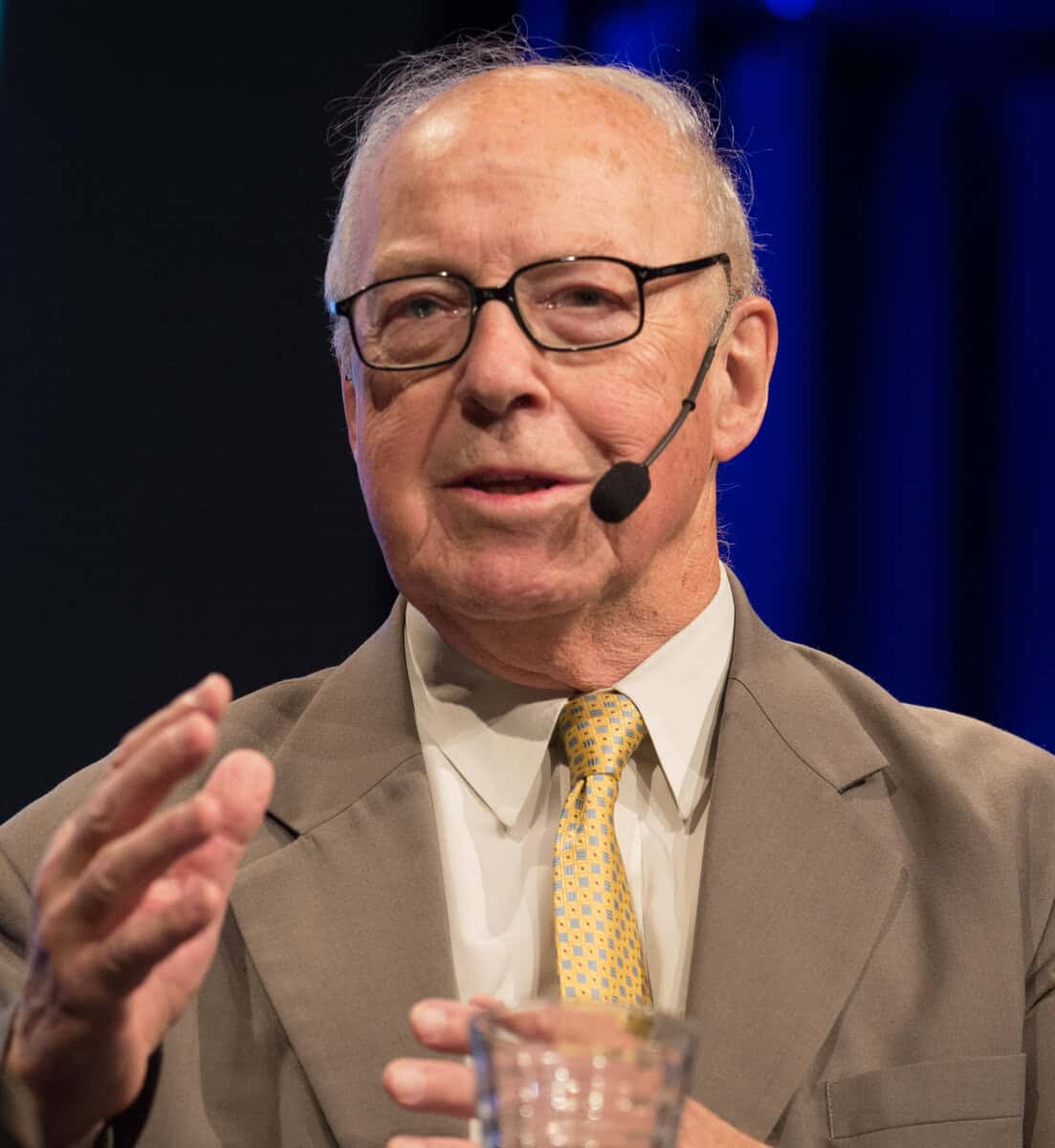
Hans Blix is a prominent figure in diplomacy and the United Nations, whose career has spanned Swedish foreign policy and multilateral peace and security affairs. He served as minister for foreign affairs of Sweden and headed the International Atomic Energy Agency (IAEA) for four terms.
In 2000, he emerged from his initial public-service retirement to serve for three years as chief inspector of the UN Monitoring, Verification and Inspection Commission (UNMOVIC), a Security Council mandate through which he became known to the wider public as the commission conducted its independent work to disarm Iraq of its weapons of mass destruction.
His latest book, published last year, “The Hans Blix Iraq War Diaries: 2000-2003,” is a collection of diary entries and notes on his daily life as UNMOVIC chief, offering a more intimate perspective on a period he has addressed in his earlier writings.
I talked with Blix recently while in Scandinavia about his reflections on conflict, law and public service, including the selection of the next UN secretary-general and his wishes for whoever takes on the role, among them the ability to “sleep well” and to have a “sense of humor.”
Here is our conversation, which has been edited for clarity and length. — GABRIEL ELKEIY
Gabriel Elkeiy: How would you trace your inclination to embody the identity of what constitutes an international civil servant: apolitical, guided solely by the principles of the Charter and other key documents of the UN, meticulously impartial, just as in national public service, and inspired by its highest standards, which are key components of the proper functioning of institutions? How much of such an alignment is attributable to personality shaped from early on in childhood and adolescence and how much is due to compliance with obligatory rules and procedures as a professional adult?
Hans Blix: Civil servants of the UN as well as of states need not be devoid of personal political leanings and political views, but they must be dedicated to looking for and presenting data and reasonings relevant in a factually comprehensive, independent and evenhanded way. I wholeheartedly accepted this code of conduct that is enshrined in Article 100 of the UN Charter and has important roots in the Roman law principle “Audiatur et altera pars” (“the other party must be heard”). It permeated the concepts of fairness and justice that fortunately prevailed in my country from family and school levels to those of government and judicial system.
Although as a student and young academic I had been politically active [in the Liberal party], especially in international issues, I fully supported the institution of civil service that enables states to hire competent staff without regard to their political leanings and to change of government without wholesale changing administrative machineries. As a Liberal, I was chosen by a Social Democrat Foreign Minister [Osten Unden] to be international law adviser, and I loyally served his and several other Social Democrat governments. Had I encountered a situation in which my own conclusion on facts, law or action differed sharply from those of the national government or international institution I served, I might have resigned. It did not happen.
Elkeiy: You mention in your writings and public interventions the notion of the global “public mind” as a significant deterrent to interstate conflict alongside military capability, diplomacy, economic interdependence and legal norms. Could you walk us through the main stages of its construction and whether you think it has been incrementally shaken by the unregulated post-Internet era?
Blix: In my book “A Farewell to Wars” [2023], I placed some hope in the role of what I called the “public mind.” It sounds nebulous, and I admit it is. Looking back on the long history of humanity, we see the endless tracks of cruelty and blood — the killing of prisoners taken, the razing of habitats, the genocides. We find the public sometimes supportive of their rulers’ armed campaigns, especially those in defense of their territory, but we find also rare meetings like that in Nicea (323 A.D.), dedicated to peace or that convened in 1139 banning the use of crossbows.
More recently in humanity’s history, during the 18th century, the Enlightenment swept an educated Western public with a wind of rationality, including the message that the purpose of battle was to disable enemy soldiers from armed action, not to cause them pain or death. Civilians were irrelevant to the battle and should be left in peace.
In the 19th century, peace movements urged the use of arbitration for the settlement of disputes between states and mitigations in armed struggles. The Red Cross and humanitarian conventions came into being. A world peace conference was convoked at The Hague in 1899 at the initiative of the Russian tsar. It produced detailed rules on land warfare and created a permanent court of arbitration. The evolution was supported and pushed by a broad public opinion that wanted to reduce the role and brutality of war. That public mind has also been behind the long 19th-century processes of abolishing slavery, the eroding support of colonialism, the end of corporal punishments and the 20th-century phasing out of the death penalty.
Within the span of a few centuries, we have witnessed a remarkable mental evolution away from the use of force and brutality and toward humanism. The grimness of World War I and the publicity around it strengthened the abhorrence of war and created support for US President Wilson’s project of a League of Nations and for the concept of collective security and plans for disarmament.
The peace train moved on to the 1928 Briand-Kellogg Pact under which the parties renounced war as an instrument of national policy. While the train was horribly wrecked by World War II, the judgments of the Nuremberg tribunal, the UN Charter, the Human Rights Declaration and conventions have reasserted the humanitarian drive of the public mind.
Weapons and means of warfare are constantly developing but public resistance to their use becomes visible repeatedly — in demonstrations against nuclear weapons, in US public reactions against “forever wars” and in Russia against what its government is constrained to euphemistically term “a special military operation.”
To reduce the risk that interstate armed force will be used one would wish all governments to pursue foreign policies and diplomacy that have greater regard for neighbors’ interests and always avoid humiliating other nations. The continuously growing international proximity, interdependence and integration of nations and a continued active humanitarian public mind are factors that give me hope.
The wild, chaotic flow of information that drowns the world raises risks of inciting violent actions, but it also multiplies our sources of knowledge and enables us to identify the reality and devise policies based on it rather than on fakes.
Elkeiy: Do you believe that ethics, whether they emanate from monotheistic religions or any other religions, philosophies or the most studied and comprehensive codes of conduct are empirically the optimal path to survival and durable thriving for individuals? Why does this counterintuitive approach of a convergence of the notions of selfishness and altruism seem so hard to reach?
Blix: Religions and philosophies offer codes of behavior and guides for people and governments. They build on much experience and thinking. Often their guidance leads to tolerance and restraint in or renunciation of the use of force. The most radical advice is against the use of force even in self-defense — “turn the other cheek.” Sometimes, however, religions and philosophies condone or even commend “eye for eye” or “massive retaliation.” Floods of blood have flown with blessings of religions and philosophies.
One reflection that I have is that competition is part of the human heritage — individuals as well as tribes and nations. Awareness that it may lead even to the use of force and death has prompted human societies to develop norms and inducements of restraint. In nations, they are expressed in extensive and rather effective penal codes that define and deter the use of force that it outlaws. In the UN community of states, the code is short and so far of uncertain effectiveness. My hope is that the public mind will continue both to develop and strengthen the global norms of restraint.
Another thought I have is that today the awareness that nuclear and some other weapons are capable of destroying the living conditions of human civilization may be leading not only to a taboo on the launching of such weapons but also to general restraints by nuclear armed states for fear of the risk of escalation to war.
Elkeiy: You have talked numerous times about the central role of dignity in understanding the motives behind defiant behavior. Do you think that a major feature of conflict-prone individuals lies in their inability to feel, see and grasp the inalienable reality of dignity as an anchored feature of the human condition? Should dignity be an overarching, superior, irreversible compass embedded clearly in law to preserve and cement thresholds of mutual respect and cohesion?
Blix: I agree that dignity is an “anchored feature of the human condition” and I think failures to pay attention to it are often due to insensitivity or underestimating its importance for the success of negotiations or their long term results. A demand for respect for the dignity of states may perhaps be said to flow from the principle of sovereign equality of states that Article 2:1 of the UN Charter declares the organization to be based upon. That principle does not, to be sure, stem from some law of nature and is frequently ignored — most glaringly in the veto right given to five great-power members [Britain, China, France, Russia, US] of the Security Council. Nevertheless, it has roots both in attitudes of civilian fairness and comity and, I think, in self-interest.
Nations, like individuals, normally have some self-respect and pride themselves for some things. To humiliate or to ignore a nation’s — or a person’s — sense of pride may provoke more long-lasting and more hostile feelings than the infliction of economic or physical pain. The past colonial status of Hong Kong or Goa was probably causing China and India less economic or political pain than it was evoking humiliating memories and hurting pride.
Iran takes pride in having mastered the technique of enriching uranium for use in nuclear reactors — an activity allowed under the Non-Proliferation Treaty to which it has adhered. Iran’s rejecting the demand of a total abandonment of enrichment, which the US and Israel allege aims at weapon production, may perhaps be based more on pride and a wish to be self-supporting on nuclear fuel than on any secret ambition to produce a nuclear weapon.
To demand that respect for dignity — beyond personal and procedural — should be a superior compass in all negotiations would be going far, but negotiating parties should be aware that negotiations may fail or their results may not be durable if the other side is humiliated in procedure or substance.
Elkeiy: Fittingly, we are witnessing the period leading up to, in the weeks ahead, the selection of a new UN secretary-general. As a former head of an international organization in the UN system for 16 years, leading more than 2,000 staff members from around 100 countries, what do you wish for her or him in areas in which to keep in sight?
Blix: I would wish her or him first, the ability to sleep well — to get moments of rest from the many momentous matters that the UN secretary-general [UNSG] must keep in sight at any given time. There are the overarching risks of humanity’s quick suicide through a nuclear holocaust and slow suicide by destroying its own environment. On the other hand, there are hopes of humanity attaining prosperity for all through peace, more developed international organizations, a prudent use of resources and avoiding overpopulation and a perspective of “standing room only.”
The UNSG is not acting alone but with the help of a big organization and needs to develop close, warm relations with a huge staff dispersed over the world, administer it with fairness and respect for UN rules, benefit from its dedication to the UN’s aims and help make its multinationality an asset.
A UNSG needs to have a full awareness of the world’s big transformations since the creation of the UN: The decolonization and emergence of the multipolar world, the far-reaching but still unfinished emancipation of women, the growing recognition by a global public mind and by states of human rights. He or she needs to know the background and status of the world’s current conflicts and potential powder kegs — Middle East, Horn of Africa with Sudan and Sahel, Ukraine, Taiwan, South China Sea. . . .
He or she must establish good, open channels of communication and a practice of contacts with political, economic, regional and other leaders all over the world, notably the leaders of great powers. A keen ear, ability to communicate, empathy, endless patience and courtesy are needed qualities. A sense of humor is a great asset.
By electing an SG, the UN General Assembly singles out one person as having the confidence of all states. That confidence and the skill and ingenuity of the SG are expected to be used to help solve differences or ease tensions between states or to create mechanisms for negotiations. The quiet diplomacy is one of the SG’s most important functions.
The SG’s words have great weight in shaping public opinion. People around the world listen to the SG, who is seen as the fair judge of states’ behavior — a rare arbiter who listens and weighs arguments from all sides and has the UN Charter as basis for her or his judgments. The role as opinion leader should be used with courage but also with prudence as states — not least great powers — are sensitive to criticism and may react by reducing cooperation or communication.
We welcome your comments on this article. Please keep them civil. We reserve the right to edit them. What are your thoughts?



Gabriel Elkeiy is a senior consultant in human resources as well as an independent journalist. He has formerly served in several cabinets in the UN system in Geneva and New York City.